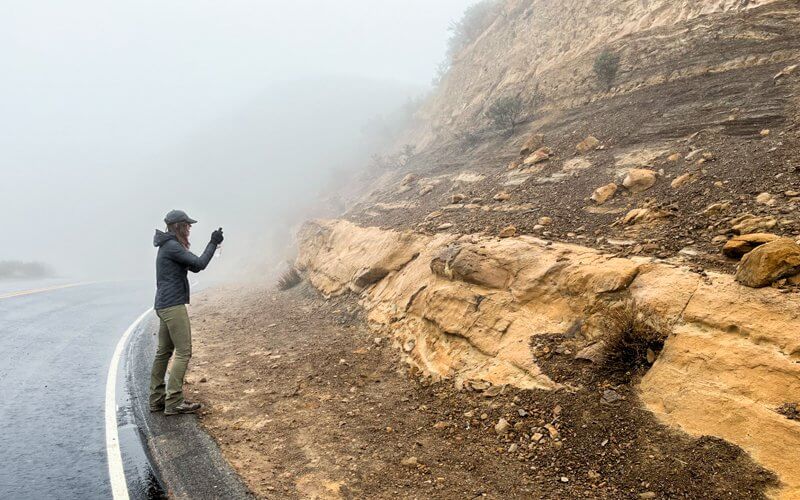
As a Cal State Fullerton student researcher, geology alum Tracy Ortega acquired the skills and education she needed to land a professional position in the scientific workforce.
During her undergraduate and graduate education, she led faculty-student research projects, learned about mapping and data collection in the field, and developed other relevant skills.
These skills helped prepare Ortega for her job as an environmental planner at Dudek, a national environmental, planning and engineering firm headquartered in Encinitas.
“At CSUF, I spent a lot of time interpreting data, reviewing maps and synthesizing complex information. These are skills that I use daily in my job when analyzing project impacts across a variety of technical topics,” she said.
At Dudek, she reviews environmental documents to ensure compliance with the California Environmental Quality Act, which involves complex regulatory permitting and documentation processes.

“Through my CSUF degree programs, I developed strong science communication skills,” she said. “A major component of CEQA involves promoting transparency with the public. Being able to translate complex findings into clear, accessible language has been invaluable.”
Ortega also works on projects related to renewable energy, such as battery energy storage systems that are not dependent on fossil fuels.
“The most rewarding part is knowing that I’m contributing to building communities that balance growth with environmental stewardship. It’s inspiring to see tangible outcomes that reflect that balance,” she said.
Ortega said studying geology and pursuing a career in the field was inspired by her late father, an avid rock collector.
As a child, she searched for rocks on the beach with him. Later, she discovered the geological wonders of Yosemite National Park.
After moving from Pittsburgh to Orange County in her mid-20s, Ortega returned to college. She enrolled at Saddleback College and saw a poster about the need for geology professionals.
Ortega took it as a sign and majored in the scientific field that studies the Earth, including rocks, minerals and the planet’s history. She later transferred to CSUF and earned a bachelor’s degree in 2021 and a master’s in 2024, both in geology.

For her master’s project with research adviser Sean Loyd, Ortega focused on carbonate concretions, a type of cementation that occurs in sedimentary rock.
She is the first author of an article based on her thesis research published in the international, peer-reviewed Journal of Sedimentary Research.
Ortega explained that cementation results from various chemical processes, driven by the degradation of organic carbon and differs based on burial depth. She studied carbonate concretions that form in deep, hot environments in Ridge Basin, near Castaic in Los Angeles County.
“Concretion studies can help us further understand the relationship between organic matter and marine sediments, providing insight into ancient biogeochemical processes,” Ortega said.
Loyd, professor of geological sciences, said the study’s results provide insight into how energy resources are generated and their potential impacts on buried sediments and rocks.
“The mineral structures Tracy studied are produced from the degradation of organic matter, which can generate crude oil and/or methane, two heavily relied upon fossil fuels,” he said.
Ortega added that studying the processes by which methane — a powerful greenhouse gas — can be released into oceans is a critical component of understanding the natural drivers of climate change.
For Ortega, being involved in research experiences and publishing her first paper helped to solidify her identity as a scientist.
“Every professor I encountered was deeply invested in their students’ success,” she said. “Having mentors like Dr. Loyd — someone who believes in you and pushes you to think critically — makes all the difference.”