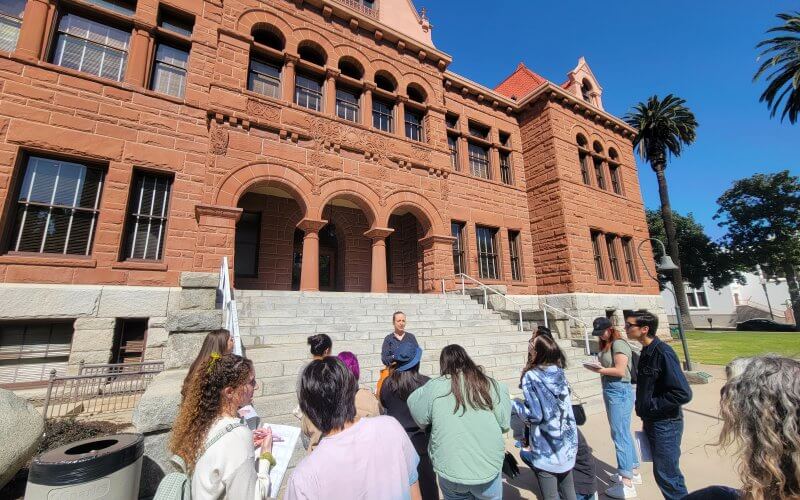
More than half of the world’s 8 billion people live in cities. At Cal State Fullerton, students can now broaden their understanding of these building blocks of society and help solve some of the problems they face by minoring in urban studies.
The new urban studies minor was created from existing courses across 10 departments in the colleges of Humanities and Social Sciences and Health and Human Development, said Zia Salim, professor of geography and the environment, who spearheaded the program with Mark Drayse, professor of geography and the environment.
Orange County is situated in a populous metropolitan area and next door to the U.S.’s second-largest city, Los Angeles, making it a great place to examine urban issues, Salim said.
Home to more than 3 million people, the county is “very large, very complex and very dynamic — and we get to study it using the tools, theories and methodologies of urban studies,” he said.
Students choosing the minor can explore the “top-down” dimensions of cities through public administration and political science classes, as well as the “bottom-up” or grassroots side via courses on Southern California culture, activism and American nightlife.
College of Humanities and Social Sciences Dean Jessica Stern said the minor “allows students to use the city to examine how broad topics like leisure, immigration, race and class are shaped by different physical and social environments.”
“Why is your commute so long? Why is housing so expensive? Urban studies asks questions about forces that produce the spaces that shape us,” said Elaine Lewinnek, professor of American studies, who teaches classes included in the minor. “Urban studies considers how cities operate on scales that are also regional and planetary.”
Geography major Marcelo Almario has long been curious about urban planning and transportation and hopes to work in the public sector after graduating. Having the urban studies minor on his resume will signal to potential employers “that I have knowledge and experience thinking about the problems we face in regards to urban issues,” he shared.
Salim said the minor offers students a variety of ways to understand cities. It can complement what students learn in their majors, and it lays a strong foundation for graduate studies or careers in local government, urban planning, criminal justice, community organizing or law, he said.
Everything about a city — public health, engineering, business or the arts — touches on disciplines that can be studied at CSUF, said Mojgan Sami, associate professor of public health. She teaches classes that count toward the minor.
“The world is more urban now than it’s ever been in the history of humankind,” she said. “That requires us to focus on the ways that we think and build and evolve and develop cities.”
In addition to two foundational courses, students pursuing the minor can choose from nearly 30 electives across a range of topics, and Salim expects there will be opportunities for hands-on projects, research and internships.
Some of his previous students produced a study of Anaheim’s park maintenance needs that helped support city spending decisions, and others edited Wikipedia articles for Orange County cities, using their research to add 24,000 words — and racking up 575,000 page views as of earlier this year.
Sami hopes that students will recognize the benefits of wide-ranging programs, such as the urban studies minor, which expose them to ideas outside their main area of study and help them see the world in new ways.
“How amazing that we can have a cross-disciplinary minor that can bring students across campus together and help build bridges for a better world that we all dream about.”