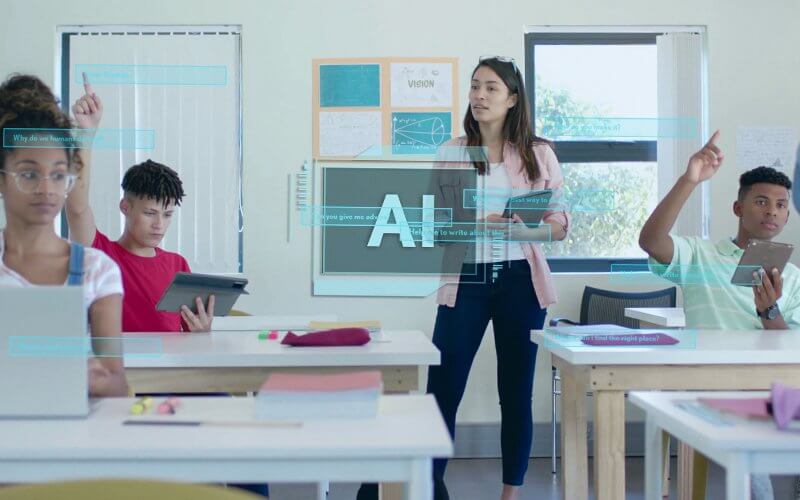
Cal State Fullerton has been awarded $500,000 in funding from Google.org to support AI literacy training for educators in transitional kindergarten through 12th grade, future teachers and university faculty.
“When teachers understand how AI systems work, including how to build, evaluate and use them thoughtfully and responsibly, they can guide students in asking good questions about technology rather than just consuming it,” said Bridget Druken, associate professor of mathematics.
The “PRISM: Preparing EducatoRs to Infuse Statistics, Math & AI” project combines summer institutes with year-long teaching clinics in artificial intelligence, said Druken, who is directing the two-year project, which starts in January 2026.
Assisting Druken with the project are Jessica Jaynes, professor of mathematics and director of the Titan Supercomputing Center; Paul Salvador Inventado, associate professor of computer science, whose research area focuses on artificial intelligence in education; and Charles E. Flowers Jr., assistant professor of elementary and bilingual education.
“Preparing future teachers in AI and data science literacy ensures they can help students critically understand how to ethically use AI, recognize bias, and engage as thoughtful innovators and producers of knowledge,” said Flowers, whose research interests include early childhood STEM (science, technology, engineering and mathematics) education.

Druken said that with CSUF building momentum around AI and innovation, including the new ECS Innovation Hub, the project creates a model for how faculty, future educators and classroom teachers can learn about AI together in ways that center on equity and practical classroom application.
“Participants will collaborate and support one another in unpacking, implementing and improving STEM teaching materials that use AI tools,” Druken said.
Flowers added that the project’s collaborative structure helps to break down boundaries between university faculty, future teachers and practicing educators.
Undergraduates, students in teaching credential programs, current TK-12 teachers and CSUF faculty will participate as fellows for a period of two years.
“By learning together, we’ll be building sustainable capacity for ethical, equity-centered AI and data science education that can extend well beyond the life of the funding,” Flowers said.
Undergraduates and students in teaching credential programs will learn data science and AI concepts alongside experienced classroom teachers, serve as peer mentors and codesign lesson materials together. The student teachers will pilot what they’re learning in local school classrooms.
“It’s a meaningful way for future teachers to enter the profession with practical skills, relevant experiences and a supportive professional network already in place,” Druken said.
The research team is partnering with Fullerton School District, Fullerton Joint Union High School District and Norwalk-La Mirada Unified School District. Fifty practicing teachers in grades TK-12 will be selected to participate as teacher fellows.
Faculty members from across colleges, including those involved with teacher preparation, will also participate in the project. The faculty fellows will enhance their AI and data science literacy, redesign curriculum to embed these competencies in credential preparation courses, and model effective integration of AI tools and ethical frameworks.
Druken, a mathematics educator and co-director of CSUF’s California Mathematics Project, has spent the past decade working with elementary, middle and high school current and future teachers on how to make math meaningful and accessible.
The new project builds on Druken’s recent work with “Project Infusing Data Science Education Into Elementary Math.” She and colleagues are partnering with elementary-level teachers on data science education in math classes.
“PRISM extends that work by adding AI literacy and bringing together classroom teachers and future teachers across grade levels to learn from each other,” Druken said.