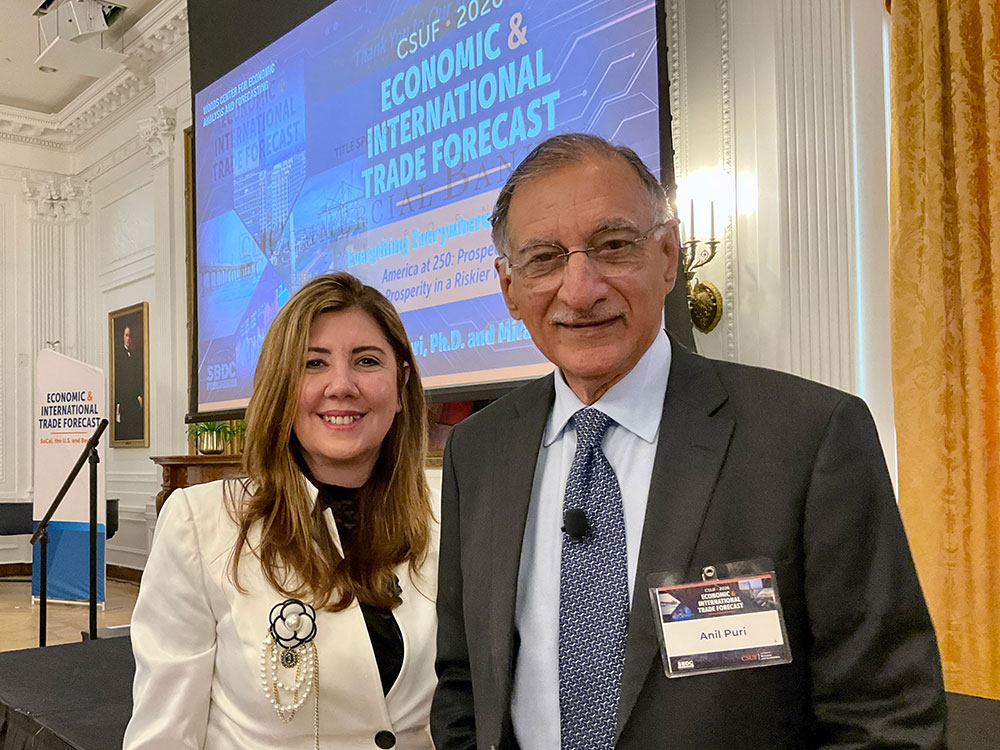
As conflict in Iran rattles energy markets and tariffs reshape global trade, Cal State Fullerton economists offered expert insights on the fast-changing economic landscape in their 2026 Economic and International Trade Forecast.
Woods Center for Economic Analysis and Forecasting Director Anil Puri and Co-director Mira Farka discussed national and regional trends, global trade, gas prices, and the housing market at the 2026 Southern California Economic and Global Trade Forecast.
Tariffs have become a key feature of geopolitical strategy, said Farka and Puri. While the time for “peak tariff uncertainty” is past, a more durable, institutionalized tariff structure is now in place, the report stated.
Driven by geopolitical conflict, gas prices are high and a major source of inflation pressure on the economy. Farka and Puri expect prices to remain elevated in the short term. However, they added that the U.S. economy is a lot less sensitive to energy “shocks,” like the Strait of Hormuz closure. The effects have been relatively mild compared to other shocks in past decades, Farka said.
A recent NerdWallet survey found that about two-thirds of U.S. consumers expect a recession in the next 12 months, but Farka explained that this scenario is not likely.
“We think the economy is battered but not broken,” said Farka, CSUF professor of economics. “We think of resilience amid anxiety. We don’t think there’s going to be a recession or stagflation.”
California’s housing market in 2025 also fell short of expectations due to weak consumer confidence and economic uncertainty: “In Southern California counties, housing prices seem to be cooling. We’ll see what happens in the future,” Puri said.
Meanwhile, artificial intelligence is also reshaping employment and the regional and national economy. Farka and Puri expect AI investment to boost growth over the next two years. Overall, the economists expect the U.S. economy to weather the current global supply shock with relatively few bruises. While inflation could rise and growth to slow in the middle of the year, the outlook for the months after appears brighter, they said.