For Cal State Fullerton business administration-marketing major Lauren Schuerger, researching ways to persuade young people to sign up as bone marrow donors wasn’t just a class assignment.
It boosted her resume, built her confidence and gave her the satisfaction of helping people.
Working with NMDP, formerly Be the Match, was a rewarding process that taught Schuerger about nonprofit marketing and gave her practice gathering and analyzing data.
“This was more than just getting a grade. It was ultimately helping the bone marrow foundation increase registrants and save lives in the long run,” Schuerger said.
NMDP maintains a registry of about 42 million people worldwide who are willing to donate bone marrow or blood stem cells to compatible patients with cancers and other disorders of the blood.
Because the likelihood of a successful transplant is greater with younger donors, NMDP’s target demographic is donors who are 18 to 35 years old and ethnically diverse, so “college campuses are absolutely where we need to be,” said Jackie Chandonnet, the NMDP Foundation’s West Coast development director.
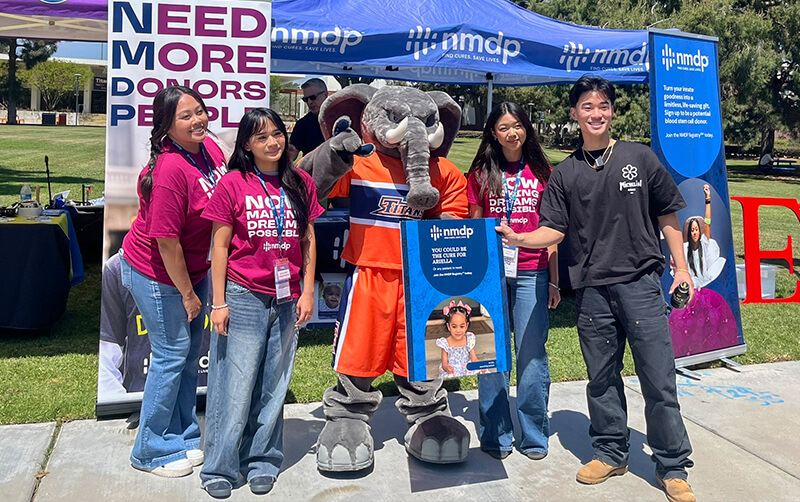
Partnering with the nonprofit, CSUF students drafted research proposals, created a questionnaire, gathered data and checked its quality, and produced a final report with recommendations on how to increase NMDP’s visibility and the most effective ways to reach young people.
The report’s suggestions include creating a mascot to appear at campus events, collaborating with health organizations, partnering with influencers, reaching out to students majoring in health- and science-related fields, and using NMDP’s mobile app to offer transparency and keep potential donors engaged.
NMDP is now implementing some of the ideas from the students’ research. Chandonnet said the organization recently established a chapter on campus and hopes to add others across the California State University system.
“These students’ feedback and work on this project are critical to our success, not just at Cal State Fullerton, but to really inform how we can work better with students and campuses and colleges across the country,” Chandonnet said.
The partnership has been great for students, too. Neil Granitz, CSUF chair and professor of marketing, said companies want to hire graduates with real-world experience, and they look for soft skills like being able to communicate well, give a presentation and work with a team.
The project is popular with students because they get to share their marketing ideas with a real organization, and they approach it thoughtfully because it has human stakes, Granitz said
CSUF’s collaboration with the nonprofit originated with Robert Zimmer, professor emeritus of marketing, whose wife, Wanda, received a successful stem cell transplant through NMDP. Zimmer wanted to help the organization that saved Wanda’s life, so in 2016 he and Granitz had students study their peers’ awareness of the marrow donation registry.
Years later, Chandonnet met the Zimmers, whom she called “the heart and soul of the project,” and they began discussing follow-up research to see how NMDP could increase its visibility with college-age youth.
Granitz worked with them to develop the spring 2025 class project. The Zimmers came to campus to hear the students’ findings, and Wanda said she was impressed, adding, “I am a product of somebody who decided to step up to the plate one day and save a life.”
Schuerger said she felt more passionate when presenting her classmates’ research, knowing that it would benefit others.
Post-graduation, Schuerger will start her career as a sales representative for an international corporation. Working with the marrow donor nonprofit “gave me the confidence to work alongside companies and actually make a real-world impact,” she said.