For 169 undergraduate and graduate student presenters, this summer was an opportunity ask questions, test ideas and contribute new knowledge.
Hosted on Aug. 6 by the Undergraduate Research Opportunity Center and Project RAISE, the Summer Symposium highlighted work from students in the Summer Undergraduate Research Academy; Engaging Graduate Students in Research, Scholarly and Creative Activities; and Project RAISE’s Undergraduate Research Experience program.
“What makes the Summer Symposium special is seeing students transform curiosity into something tangible,” said Megan Drangstveit, director of Project RAISE. “These projects reflect not only their individual passions, but also the mentorship, collaboration and academic community that helped make the work possible.”
In her opening remarks, Nicole Bonuso, who served as UROC director during this year’s symposium, reflected on the commitment students demonstrated throughout the summer.
“Our students took on complex challenges, asked meaningful questions and committed themselves to learning beyond the classroom,” Bonuso said. “We’re proud to celebrate the results of their work.”
Presenters represented CSUF and other partner institutions, including Citrus, Cypress, Fullerton, Golden West, Irvine Valley, Orange Coast, Saddleback, Santa Ana and Santiago Canyon colleges.
Learning Beyond the Classroom
For Megan Williams, a liberal studies major and SUReA participant, summer research meant stepping beyond traditional disciplinary boundaries.
Guided by faculty mentors Jin Woo Lee, associate professor of mechanical engineering, and William Hoese, professor of biological science, Williams presented a biomimicry-inspired smart cane prototype that uses ultrasonic sensing and haptic feedback to assist visually impaired users.
“What surprised me most was how interdisciplinary the work became,” Williams said. “I’m a liberal studies major, so I had to learn how to lean on other people’s expertise while contributing my own. That’s what helped turn the idea into something real.”
The experience also challenged Williams to see herself in new ways.
“It took a lot for me to overcome and step into STEM,” she said. “Working alongside engineering students and learning new skills showed me how many different perspectives are needed to solve problems.”
Williams, who hopes to become a mild-to-moderate support needs education specialist and assistive technology researcher, said the experience showed her how research and technology can be used to improve accessibility and quality of life.
Research With Purpose
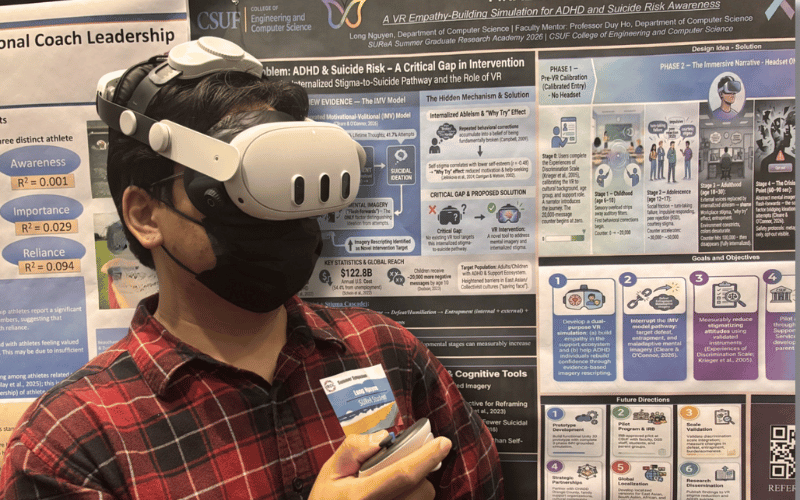
Computer science student and SUReA participant Long Nguyen presented “Finally Seen,” a virtual reality experience designed to increase awareness of ADHD stigma and suicide risk.
Developed with faculty mentor Duy Ho, assistant professor of computer science, the project uses immersive storytelling to help users better understand the experiences of children living with ADHD. Through an interactive narrative, participants encounter the negative messages that many children with ADHD experience throughout their lives.
“What shocked me most is how early ADHD stigma starts,” Nguyen said. “Many children receive more than 20,000 negative messages by the time they’re around 10 years old. I wanted to create something that helps people understand what that experience can feel like.”
Ho said the goal was to help others better understand the realities of ADHD stigma.
“Our focus became turning the idea into a practical VR experience that people could engage with,” Ho said. “The environment interacts with the user, allowing them to step into someone else’s shoes and better understand the impact of those experiences.”
Research Takes Many Forms
The symposium also demonstrated that discovery can take place well beyond a laboratory.
CSUF undergraduate student Lyss Olaes presented research examining portrayals of ADHD in the “Percy Jackson” franchise through the lens of disability studies and rhetorical criticism. Her work explored how media representations influence public understanding of neurodivergence and introduced a concept she and faculty mentor, Erika Thomas, professor of human communication studies, call “disability dissolution.”
“We started calling it ‘disability dissolution’ when a story introduces disability as a plot device, but then it’s never really talked about again,” Olaes said. “I wanted to explore the difference between representation that feels authentic and representation that treats disability as a gimmick.”
Olaes and Thomas hope to further develop their concept of “disability dissolution” through future scholarly publications, including a proposed book chapter.
Training the Next Generation of Scholars
While projects differed in discipline and methodology, nearly all shared a common foundation: mentorship.
Students participating in SUReA, EG-RSCA and URE spent the summer working closely with faculty mentors, developing research skills, presenting findings and gaining firsthand experience with the process of discovery.
For Ashley Mendiola, who participated in URE while attending Irvine Valley College before transferring to CSUF this fall, the experience reinforced the value of collaboration and mentorship.
Working on a wildfire mitigation project, Mendiola helped design and 3D print protective enclosures for a network of environmental sensors to detect fires in their early stages.
“I came into the program nervous as a community college student because I wasn’t sure if I’d be at everyone’s level,” Mendiola said. “But everyone was so welcoming, and we learned from each other. We identified our strengths and were able to work together.”
Mendiola said faculty mentor Ankita Mohapatra, associate professor of electrical and computer engineering, helped broaden her perspective on engineering and problem-solving.
“Dr. Mohapatra showed us different perspectives and helped me think about the future ahead and where designs can be improved,” Mendiola said. “It changed my thought process from just solving the immediate problem to thinking about what’s next. It was a marvelous learning experience.”
Binod Tiwari, associate vice president for research and sponsored programs, said the symposium reflects the impact of investing in undergraduate and graduate research opportunities.
“The Summer Symposium is a celebration of what happens when students are given the opportunity and support to pursue meaningful questions,” Tiwari said. “Their work reflects not only academic achievement, but also the skills that prepare them for future careers and advanced study.”
As attendees moved between posters, asked questions and exchanged ideas, the symposium highlighted a summer of growth, discovery and collaboration, and how research experiences help students envision what’s next.