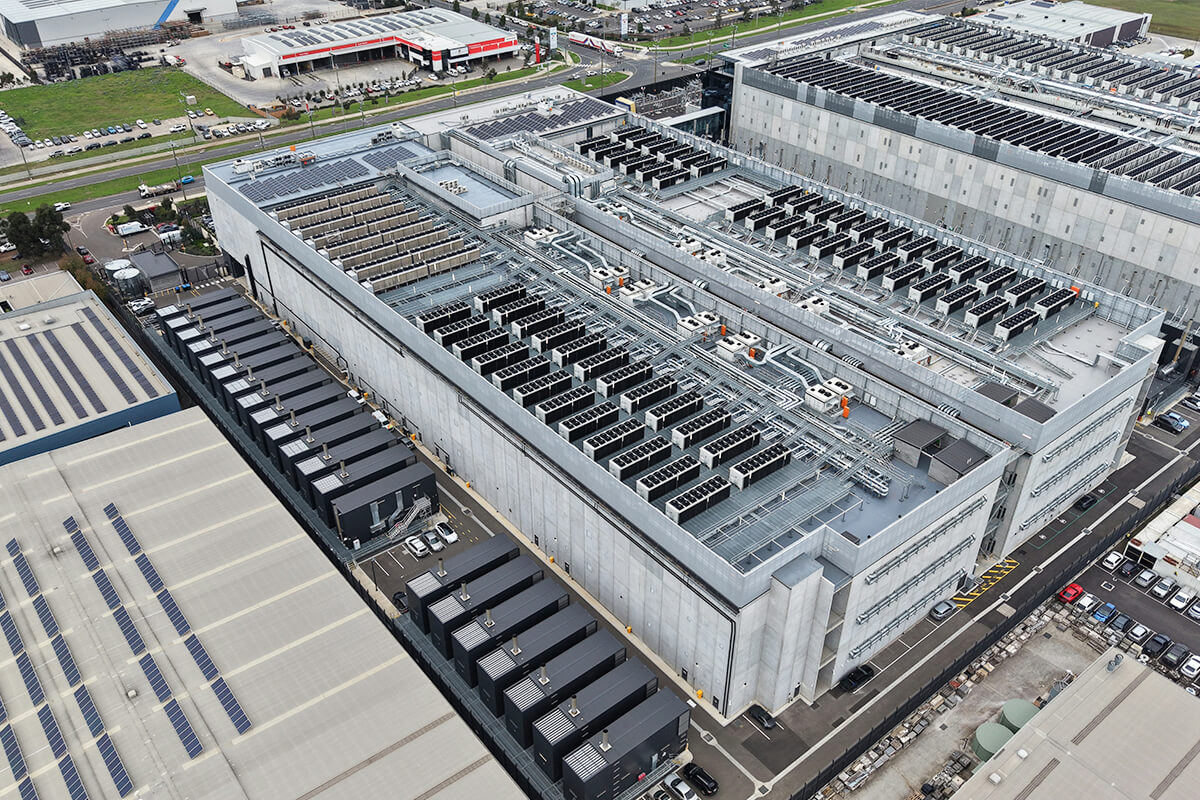
David Adams is an Associate Professor of Public Administration in the College of Humanities and Social Sciences who is an expert on data centers. CSUF News recently caught up with him to discuss water, energy, data centers, the government’s role in greenlighting data centers, and long-term impacts.
CSUF News: What’s your research about?
Adams: A lot of my research has been in oil and gas and energy infrastructure. I’ve been focused on that for a while, as well as water. My initial dissertation research focused on institutional collaboration in watersheds across the country and how people come together to improve water quality. I just published a book on that in May 2026 with Jonathan Fisk and John Morris, Navigating Water Quality Outcomes in American Watersheds (Cambridge University Press). I also have studied energy—oil and gas infrastructure.
You are in the public administration division. How does this relate to oil and gas?
Adams: I’m wondering how government agencies maintain legitimacy, achieve their goals, and serve every community fairly. Legitimacy means the public seeks their work as not just legal, but also important and valid.
What’s the topic of your latest research?
Adams: Data centers. A few of us working together on this research have come to realize that data centers are really similar to oil and gas infrastructure. The public initially sees a benefit in the build-out of a data center. If a new oil field is taken over by a gas company that comes in there, it builds out all the infrastructure, and there are a lot of jobs right away. Then, once it’s built or once the oil companies move on, the jobs go away. So [for energy companies], what’s still there is just the producing ground where the benefit is not local but spread out everywhere, while the cost is really local.
Data centers are similar; they’re put in one spot by a multinational corporation whose dollars are everywhere. The people living in that area are getting some benefit from the build-out, but the costs are borne locally, and those benefits are spread across all of us. We’re all benefiting when there is a new data center put in the middle of the Sonoran Desert, right? Our phones work faster; we’re able to do cool, flashy things [on our computers]; we’re able to talk on Zoom. But the costs are really on the environment right there locally in Arizona, where the data centers operate.
Quantify the data center story for us. What’s the scale of data center construction in the US?
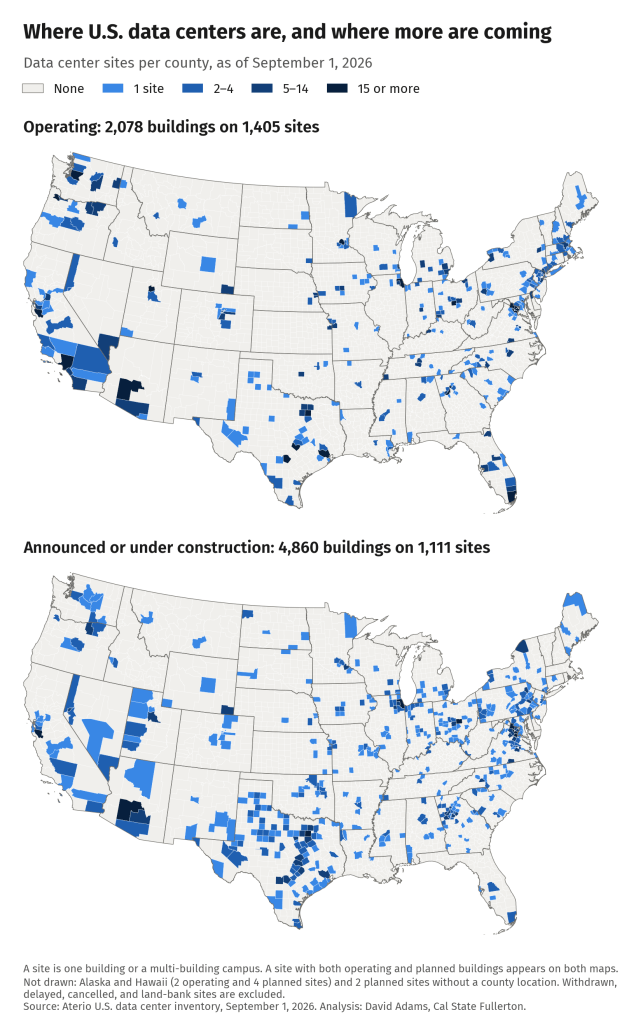
Adams: There are 7,000 data center buildings operating, proposed, or under construction across the country, and about 2,100 operating right now, on roughly 1,400 sites, as of Sept. 1. Some of these are single buildings. Some of them are 30 buildings across 190 acres of land.
What are the initial perceived benefits of data centers for cities?
Adams: Cities and counties like the fact that the data center is a new source of tax revenue is coming in, but it’s not like it’s a factory that is going to require workers, apartment buildings, neighborhoods, new street maintenance and new school capacity. It’s just a new building that’s producing tax dollars and paying land rent. It’s great revenue. You don’t have to fund increased road pressure, but you don’t have to absorb new capacity of the schools to handle the students. [The city] is just getting more money.
And the downside of data centers?
Adams: The “down the road” risk for data centers for these communities is the same one we see with the abandoned and orphaned oil wells. The infrastructure is going to be stranded eventually, because the technology is going to move on. In the meantime, the environmental costs are local. A big campus can use as much electricity as a small city, and many data centers cool their servers with water, often in places like Arizona that are already short on it. When a data center switches to air cooling to save water, it uses more electricity, so some of that water use just moves to the power plant.
Who makes the decision to approve a data center? Which governing body/bodies?
Adams: The governance is so fragmented. There are so many different governments that are involved: state, local, special district, commissions. Tucson is a really interesting case. A developer with Amazon Web Services as its customer wanted to build a data center there. They went into the county and got a bunch of land. But the city said they couldn’t have access to water. Then they redesigned it to cool with air, so they didn’t need the city’s water. They then went to the Arizona Corporation Commission, the state utility regulator, and just asked for access to electricity. So the commission approved the power deal. This was in contrast to the city, where the public showed up with signs and picketing and the council voted no. But the commission said yes, and the county had already sold them the land.
So what happened? The fences go up, the bulldozers come in, and all the public is standing there at the fence saying, “Look, we said no, why are you building these things?” And the whole thing was a mismatch of institutions. This is just one case in Arizona.
There could be 15 different governments involved, and the public could be arguing with the wrong government.
You have your own database on data center growth. What sort of information are you tracking? Any interesting trends?
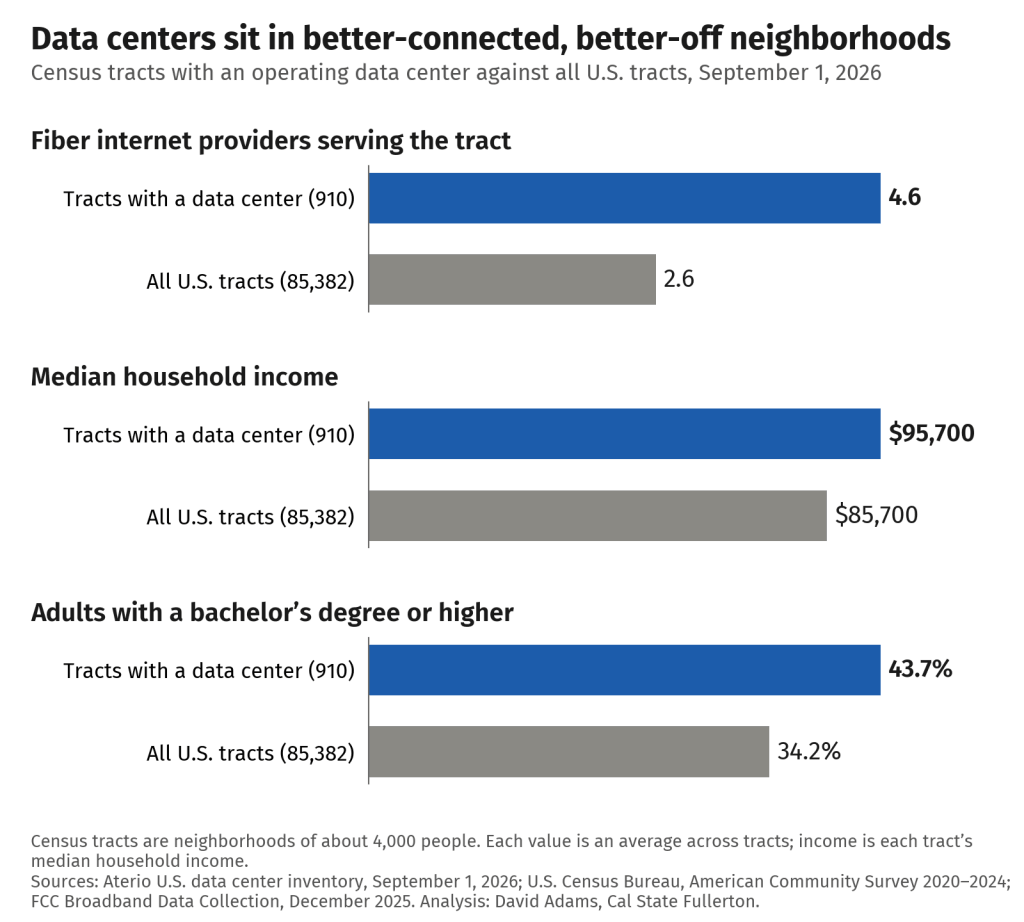
Adams: I really do have a huge database that I’ve gathered. I have gone out and searched maps to find where data centers are located. What I found so far is that the data centers are following the fiber. Where the internet cables already are, which is typically in more affluent areas, better educated, more money, that’s where these things are being located. They’re following that because that’s the best location for it because it’s the easiest access to connect to the infrastructure .
What else?
Adams: They’re also following the energy. So if there’s cheap coal right beneath it and they’re going to use coal-fired power plants to produce it, then they’re going to site it there. I think energy and fiber are the two things that draw [data center construction]
Some of these locations are unknown but also unreachable. You don’t have a council meeting and some board that meets. It’s not like the public can go and express that they don’t want this.
Let’s look at the local landscape for a minute. How might the landscape in California be different for data centers, given recent news?
Adams: California just applied a lesson the oil and gas world learned the hard way. The seven bills Gov. Newsom signed on Sept. 21 make data centers pay for their own grid upgrades and back their long-term power contracts with security so if a data center closes, ratepayers aren’t left holding the bag. Oil and gas companies had to post bonds, too, but the amounts were far too low to cover cleanup, and that’s a big part of why we have so many orphaned wells.
So, the question for California is whether the security is big enough. The water bills also make proposed data centers report their water use and drought planning to local governments and water suppliers, which puts that information in front of the governments people can actually reach.