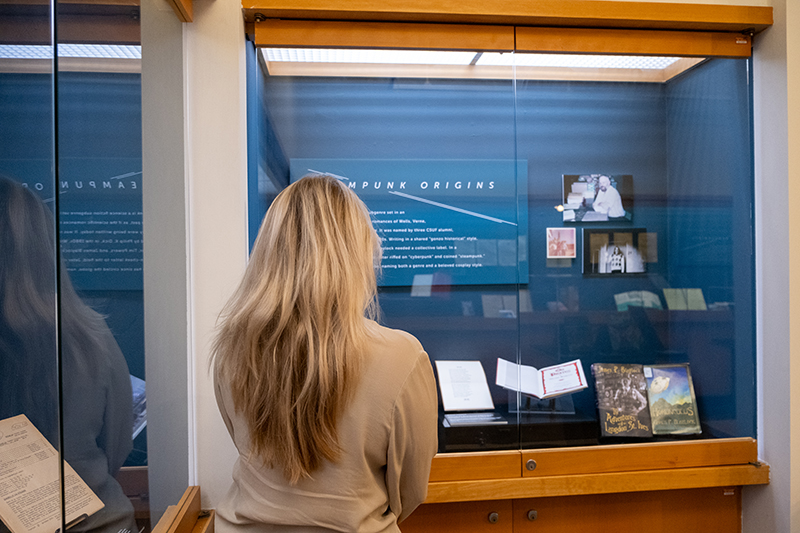
From Philip K. Dick to Chicanafuturism, Cal State Fullerton’s science fiction exhibit explores who decides which stories are worth remembering.
The Pollak Library is currently hosting “Tomorrowlands and New Frontiers: Science Fiction in Pollak Library’s Special Collections,” an exhibit that showcases the evolution of one of the most recognizable genres in literature and popular culture: science fiction. Originally scheduled to close earlier, the exhibit has been extended through Dec. 18 due to its success.
Curated by David Sandner, professor of English, comparative literature and linguistics; Hunter Huang, assistant professor of art; and Patrice Prestinary, archivist and special collections librarian in Pollak Library’s University Archives and Special Collections, the exhibit spans more than 100 years and showcases how writers from the early 19th century to today have blurred the lines between science and fantastical storytelling.
Science fiction is so ingrained in our pop culture that many don’t realize the term itself is relatively new, even if its earliest roots go back centuries.
Early pioneers include Mary Shelley, with her “Paradise Lost”-quoting monster in “Frankenstein,” and H.G. Wells, with his timeless book, “The Time Machine“. But it wasn’t until 1926 that Hugo Gernsback popularized the term “scientifiction” through the magazine “Amazing Stories,” which later evolved into “science fiction,” according to Encyclopaedia Britannica.
As it turns out, Fullerton, California, and specifically Cal State Fullerton, have several unexpected connections to the history of science fiction. These include the coining of the term “steampunk” and the legacy of author Philip K. Dick. Notably for Fullerton, Dick’s novel “A Scanner Darkly” features recognizable Fullerton and Orange County locations.
The collection wouldn’t be where it is today without the foresight of former CSUF English professor Willis McNelly. According to a 2016 CSUF News article, McNelly began collecting many of these materials years ago, back when few considered science fiction to be a serious literary genre. He would approach science fiction authors before they achieved wide recognition and encourage them to donate manuscripts and other materials to the university.
From original “Dune” manuscripts and Philip K. Dick’s ties to Fullerton to the growing recognition of Chicanafuturism and Latinx science fiction, discover how CSUF is helping preserve the stories that shape our understanding of the future.
Read the full story on HSS News.