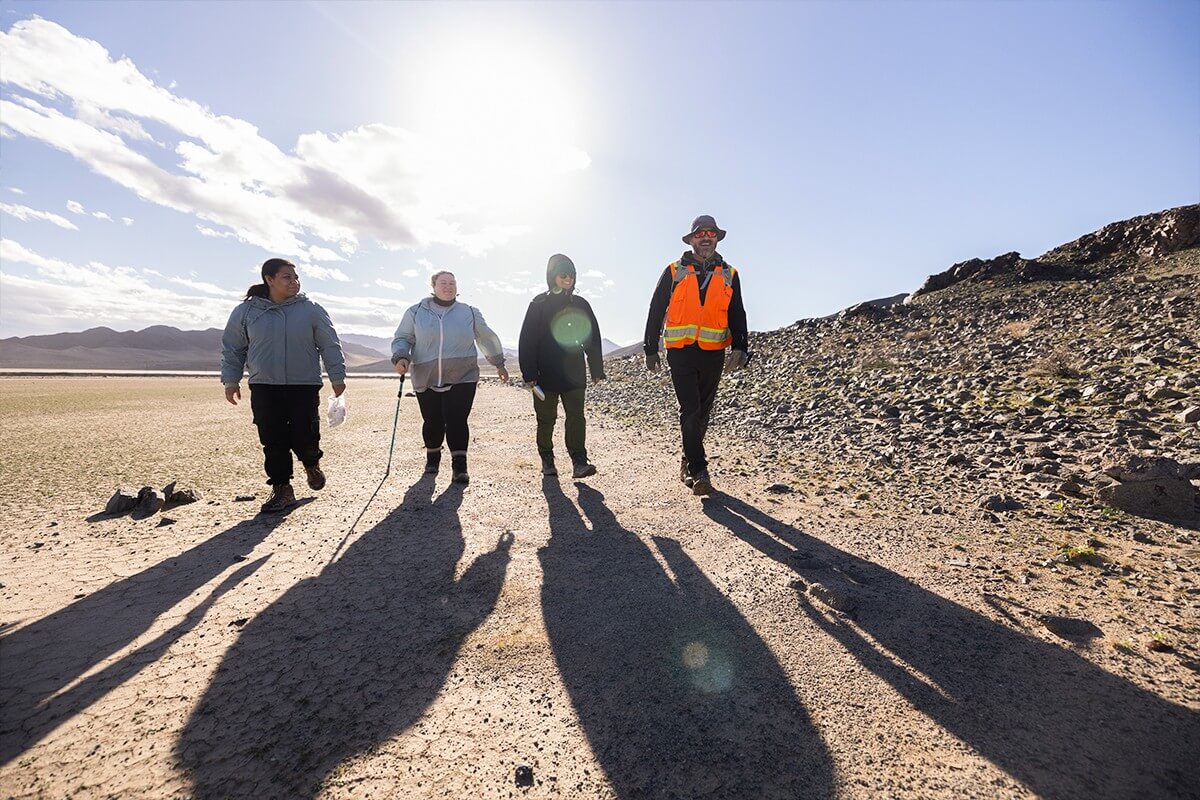
Titan grad student Alondra Ruiz Contreras conducted research in a classroom and laboratory that is located in a unique place — the heart of the Mojave Desert.
The geology student is part of a team of aspiring scientists and professors who study at the California State University Desert Studies Center. Ruiz Contreras first visited the center while taking a course with Matthew Kirby, a leading paleoclimatologist and professor of geological sciences at Cal State Fullerton. During the trip, she collected samples, practiced georeferencing, and analyzed drone footage to better understand past climates and environmental changes over the ages.
She used that fieldwork experience to co-author an academic paper on paleohydrologic conditions in the Mojave Desert, which was published on Oct. 15 in the journal Quaternary Science Reviews.
“As a first-generation student, seeing my name on the publication felt surreal. I was so excited,” said Ruiz Contreras ’24 (B.A. Earth science). “I wrote part of my thesis while I was at the location I’m studying, which was such a helpful and unique experience.”
Located in an unincorporated community, Zzyzx, in San Bernardino County about 163 miles northeast of Cal State Fullerton, the CSU Desert Studies Center has a 50-year legacy of providing students like Ruiz Contreras with hands-on research experience and skills that will continue to serve them as they enter the workforce or pursue an advanced degree.
A natural, outdoor laboratory
Since its establishment in 1976, the center has welcomed more than 86,000 visitors, including groups from multiple CSU and University of California campuses, California community colleges, other 4-year national and international universities, as well as K-12 schools, state and federal agencies, industry, and nonprofit organizations.
The center is located on the west shore of Soda Lake in the Mojave National Preserve. Both the preserve and the center were formally recognized by the U.S. Congress in 1994 with the passage of the California Desert Protection Act.
At the center’s 1,280-acre field station, students, faculty and government scientists conduct research that improves the understanding, appreciation and conservation of California’s deserts.
The center is governed by the California Desert Studies Consortium, a multi-campus affinity group of the CSU system that features faculty and administrative representatives from seven CSU campuses and the National Park Service.
This level of collaboration sets the center apart from other institutions and allows the Desert Studies Center to put students at the forefront of cutting-edge research that answers complex questions about the environment and its challenges, said Paul Stapp, a wildlife ecologist and CSUF professor of biological science.
Stapp serves as faculty director of the California Desert Studies Consortium and oversees the CSU Desert Studies Center.
“Approximately 40% of California’s land area is deserts. Deserts are at the center of some of the world’s most pressing environmental problems, including sustainable energy development, resilience to climate change and the impact of human-caused activities,” said Stapp. “Educators and researchers from around the world come to California and the Desert Studies Center to study these problems. The students that accompany them learn critical hands-on techniques and skills that they can’t master in a classroom or lab.”

In addition to using the center’s facilities, which include lodging, meeting rooms, a laboratory, a library, natural history collections and outdoor meeting spaces, student researchers work alongside and network with scientists from other academic institutions, governmental agencies, the private sector and nonprofit organizations.
Like many faculty researchers at CSUF, Stapp began utilizing the center for class field trips because it allows students to take their education into the field and practice research in an immersive learning environment guided by faculty experts and dedicated center staff members.
“For many students, the Desert Studies Center serves as a safe place for their first introduction to working and studying outdoors,” Stapp said. “We can support the largest number of guests of any remote field station in the state, including in the UC Natural Reserve system. The center makes it possible for us to create this experience for so many students.”
The consortium also offers research grants that are available to both graduate and undergraduate students. Recipients of the Judith A. Presch Desert Research Scholarships receive funds for their projects and can stay at the center for free for a year. CSU faculty can apply for Faculty Grant-Writing Support Awards, which provide support as they prepare a grant proposal to address research gaps in desert studies.
Ruiz Contreras is among the researchers helping to advance scientists’ understanding of California’s Mojave Desert. Her experience at the center informed her graduate thesis, in which she is using elemental data, such as existing grain size, organic matter and magnetic susceptibility, to infer 27,000 years of precipitation changes in the Mojave Desert.
“The facility stands out because it brings everything together. We didn’t just stay in the desert. We conducted research in the field, studied in the library, collaborated with our peers and adviser, and started writing our results,” she said.