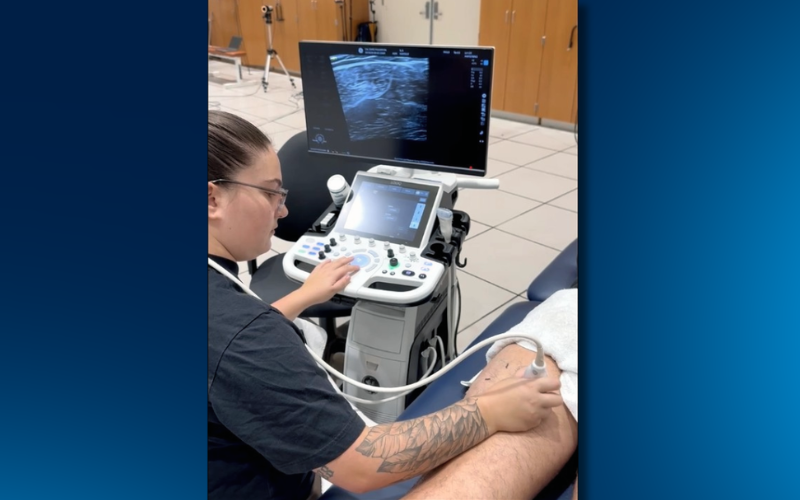
When Cal State Fullerton undergraduate student Julia Butz first emailed Shawn Hanlon, assistant professor of kinesiology and a member of the musculoskeletal health and performance research team, after finishing one of his classes, she simply wanted to say thank you.
“I really liked the class,” said Butz. “And I mentioned that his research sounded cool.”
That message sparked a mentorship that grew into a funded research project through the Undergraduate Research Opportunity Center, a unit within the Office of Research and Sponsored Programs.
Now a UROC student fellow, Butz is helping design and carry out a study using advanced ultrasound imaging to evaluate hamstring muscles. Hamstrings are notoriously difficult to measure because even a small change in probe position or angle can alter what the image captures. Ultrasound images capture only a very thin slice of tissue, so precision and consistency are critical.
According to Hanlon, “When you are looking at ultrasound, you are looking through a credit card-thin slice. You have to line that up with the exact same spot and then two months from now find that same spot again.”
Learning the Tool and Shaping the Question
Butz quickly realized she would need to develop new technical skills and help shape the study itself. Before she could collect meaningful data, she had to learn to use the ultrasound machine. Although Butz was familiar with kinesiology concepts, operating and interpreting ultrasound images was entirely new.
“The steep learning curve of ultrasound imaging is orientation,” she said. “What am I looking at? Which side of the screen is up?”
With repetition, that uncertainty faded.
“Now I can see an image and know what I am looking at because I have seen it so many times,” she explained.
While mastering the ultrasound machine, she was also helping shape the focus and procedures of the study.
“Developing a research question on its own, that was what was novel for me,” she said. “That was the frontier that I had not explored yet.”
However, it was not just about asking the right question, but also about testing whether someone new to the technique could perform at a level comparable to an expert.
“I have 10 years of experience in ultrasound. Julia has two months,” Hanlon said. “The question we are asking is whether she can take the same measurements as I. If a new learner can match an expert, it suggests clinicians with standard training might one day use the procedure reliably.”
Hanlon emphasizes that the significance of the project comes not just from the question Butz helped define, but also from the scope and rigor of the study itself.
“This is graduate-level work,” he said. “Even doctoral level in some respects, because the study design, precision and methods require careful planning and consistency.”
From the Lab to the Clinic
The study also incorporates shear wave elastography, a technique that estimates tissue stiffness while the participant is at rest. The approach avoids muscle contraction, which can be painful, especially for someone recovering from injury.
“The real value add is we do not want to provoke pain,” Hanlon said. “You are lying there, and we just click a button. It estimates stiffness for us.”
Butz sees the clinical implications clearly.
“If someone is injured, you do not always want to ask them to contract as hard as they can,” she said. “Being able to look at it in a resting position is really powerful.”
Hanlon frames the goal in practical terms.
“My focus is to conduct studies that are translatable, so you can take my results and use them on Monday in your own practice,” he said. “Julia is helping make that happen.”
Ultrasound machines are becoming more accessible in health care settings, but not every clinician has deep imaging experience.
“Not every physical therapist is an expert on hamstrings,” Butz said. “If we can prove that it is reliable, even without 10 years of experience, then clinics that already have these machines could use them to see a patient every week and quickly scan the same spot to see progression.”
Early Results and a Growing Researcher
Early findings are encouraging.
“In our short sample so far, we have been able to get similar numbers,” Hanlon said. “That is what we were hoping to see.”
“Things are promising,” Butz added. “The measurements I am taking are lining up with Dr. Hanlon’s, which is really exciting.”
For Butz, the experience has been about more than just running experiments. She has worked closely with Hanlon to shape both the research question and the study itself, learning what it takes to design and carry out meaningful research. With support from UROC, she had the funding and structure to pursue the project over the course of a year, turning curiosity into hands-on discovery.
“I am the only kinesiology major in the UROC Fellows program right now,” she said. “There are art students, music students and chemists. Even though our projects are different, we see each other all the time, and there are things I’ve learned from them and taken into this lab.”
Looking back, she credits that first step.
“It really just started with me reaching out,” she said. “If a student is interested in something, there are a lot of avenues available to explore that interest.”
What began as a simple thank you email has become research with real potential to change how clinicians monitor injury recovery and an experience that has transformed one undergraduate into a confident, emerging scholar.
By Nico Xepoleas