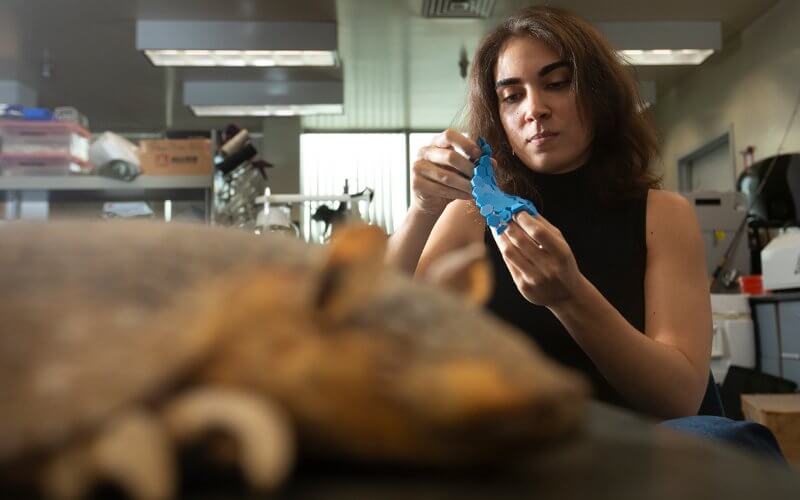
Whether it’s sharks, manta rays or armadillos, Cal State Fullerton biology grad student Julia Teeple’s omnivorous curiosity drives her to wonder what she could learn about them in the lab.
That curiosity has led to research, and research has led to publishing, giving her a track record that’s rare for a master’s degree candidate.
Just this year, Teeple has been a coauthor on two papers about how armadillos’ protective armor works and two papers sharing her research on manta rays.
“Whether I’m watching a movie or walking around a park, I find myself looking at organisms and thinking, ‘Why might they look like that?’ Or, ‘How is it that they’re able to do the things they need to do?’” said Teeple, a Class of 2026 grad.
The evolution of the armadillo project exemplifies how Teeple blends the long-practiced scientific method with today’s technology. The availability of animal samples was limited, but rather than abandon her questions about their armor, she turned to computer-aided design and 3D printing to create models.
One recent paper, of which Teeple was first author, explored why the tiles that make up armadillo shells are a tapered shape — they balance protection with mobility — and the role of connective tissues in how the armor performs.
Teeple and fellow researchers tested multiple combinations of hexagonal tiles and types of fabrics to hold them together, like an armadillo’s skin and soft tissues. The findings could suggest designs for “bio-inspired” armor.
Digital-age methods such as 3D printing improve the quality of Teeple’s work and help her explore a broader range of questions. In researching manta rays, she tested models of their food-filtering mechanism in a flow tank — experiments that are much more challenging with animal specimens.
Besides illuminating the workings of the natural world, Teeple’s research can also suggest solutions to human problems. Her work on manta rays helped explain why their food-catching filters don’t get clogged, which she said humans could apply to water treatment to remove microplastics.
“There’s so much we can learn from nature and be inspired by,” Teeple said.
Misty Paig-Tran, professor of biological science, first worked with then-undergrad Teeple on studying shark teeth, a project that earned Teeple second place in a California State University systemwide research competition. During Teeple’s graduate studies, they’ve collaborated on the manta ray and armadillo research, the latter funded by a grant from CSUF’s Office of Research and Sponsored Programs.
Paig-Tran said Teeple’s self-directed research and prolific publishing are more akin to the output of a postdoctoral researcher who spent five or more years earning a Ph.D.
“Julia has her hand in the project the whole way and is driving the experimental design,” Paig-Tran said. “She is answering questions that she has come up with on her own.”

While Teeple is especially inquisitive and driven, “the culture here at CSUF really enables her to satisfy these curiosities,” Paig-Tran shared.
Three of Teeple’s papers appeared in Integrative and Comparative Biology, and one was in Proceedings of the Royal Society B.
Publishing her research was like shining a light on educational progress that can be hard to recognize while it’s happening, Teeple said. “All of a sudden, to see that work, that growth in a tangible way was a good feeling.”
When she started college, she didn’t realize research took place on campus, she said. But studying at Cal State Fullerton and connecting with faculty sparked Teeple’s passion for it.
“I went from not knowing research opportunities existed to thinking, ‘I can do this, and I can be good at doing this.’”