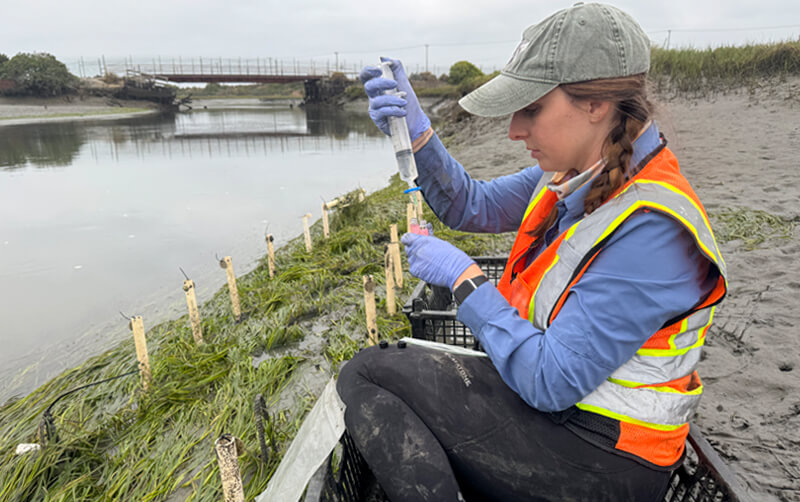
Cal State Fullerton biology graduate student Julianna Colucci is conducting fieldwork this summer at Seal Beach National Wildlife Refuge to understand how environmental factors affect the breakdown of oyster shells in coastal waters.
To help support her academic and research pursuits, Colucci is the recipient of a $10,000 award from the Aquarium of the Pacific’s Community, Equity, Learning and Persistence Scholar Program.
“As a CELP Scholar, I’ll have a unique opportunity to contribute to a diverse community of marine scientists, explore dynamic career pathways in the field of ocean sciences and interact with industry professionals,” said Colucci, who is studying marine biology.
The CELP Scholar Program seeks to broaden participation in marine sciences and support students’ persistence in the field.
“The program not only provides financial support, but also allows each student the opportunity to make valuable connections with aquarium staff and explore career paths in marine science,” said Jeff Flocken, Aquarium of the Pacific president and CEO.
Colucci was also awarded a research grant of about $7,700 through the Undergraduate Research Opportunity Center’s Engaging Graduate Students in Research, Scholarly and Creative Activities Program. The program, which currently supports 46 graduate students, is an initiative of CSUF’s Office of Research and Sponsored Programs and is partially funded by a U.S. Department of Education grant.
To further support her research efforts in Southern California estuaries, she received a $3,000 Coppel Graduate Science Award from CSUF and a $4,000 Coale Graduate Scholar Award from the California State University Council on Ocean Affairs, Science & Technology (COAST).
Colucci is working on her project with her research adviser Danielle Zacherl, professor of biological science, who is researching ways to restore the dwindling population and habitat of Olympia oysters — the only oyster native to the West Coast.
A common practice in oyster restoration is using recycled oyster shells to build a legacy oyster bed where juvenile oysters can attach and grow. Zacherl completed a restoration project in 2017, but the recycled oyster shells decomposed after a few years.
“My project is trying to answer what’s causing the shells to deteriorate so quickly,” said Colucci, president of the Biology Graduate Students Club. “Oysters help stabilize shorelines and protect against erosion and wave action, filter water and provide habitat for many marine organisms.”
Colucci’s project examines how changes in ocean conditions, water chemistry, pH and salinity influence shell deterioration, a factor crucial to maintaining healthy oyster reefs.
For her study, Colucci gathers pore water samples — collections of water in the tiny spaces between particles of sediment — at five estuary sites at Seal Beach National Wildlife Refuge, located within the Naval Weapons Station.
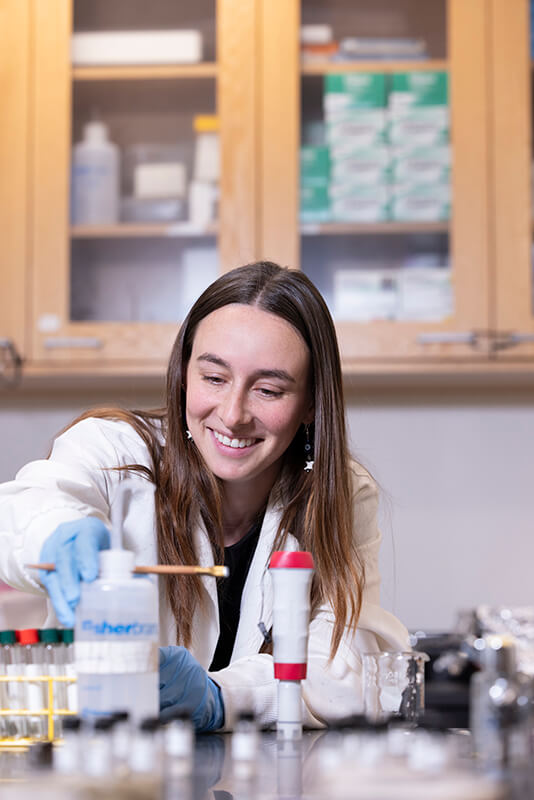
She then analyzes the water samples in the lab and uses advanced 3D imaging technology to measure changes in shell structure over time.
“As climate changes, so does the ocean chemistry,” said Colucci, who plans to pursue a career in wetland conservation and restoration. “Understanding the impacts oyster beds face can help to inform current and future restoration methods.”