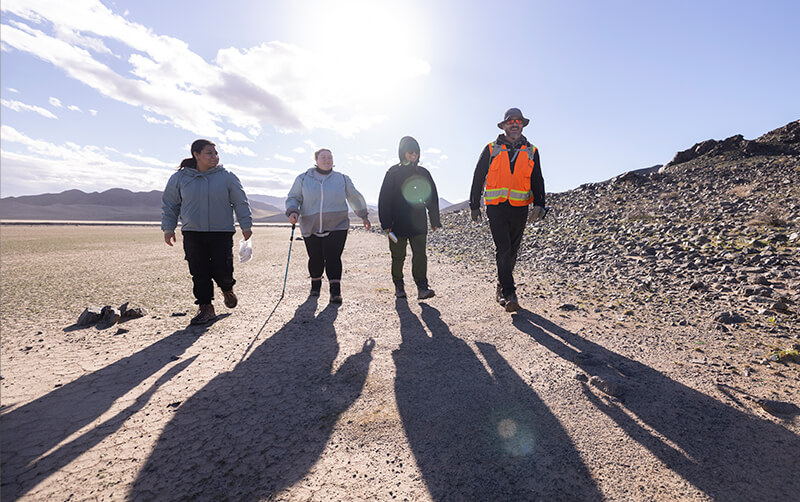
Geology student Yelitza Cabrera is studying ancient lake sites in the Mojave Desert to understand how climate change is affecting water availability in parched, dry regions.
Cabrera’s work involves taking sediment samples from Silver Lake, a dry lake bed that formed from Lake Mojave, which no longer exists.
The Cal State Fullerton senior collected tufa, a carbonate rock found along the lake’s shorelines, and carbonate microfossils buried in the sediment. Through her thesis project, she seeks to understand past fluctuations in Silver Lake’s depth and to predict water availability under future climate warming.

“The research is crucial to understand changes in the hydrology of arid regions, particularly in urban areas like Southern California, which heavily depends on precipitation as a water source,” Cabrera said.
“Understanding how a past lake system responds to climate helps reduce uncertainty about how our modern basin systems will respond.”
Cabrera is part of a collaborative research team, led by Matthew E. Kirby, chair and professor of geological sciences, that is reconstructing the climatic conditions between 8,000 and 25,000 years ago that created massive lakes in the heart of the Mojave Desert. The vast California desert is known today for its extreme temperatures and scorched landscapes.
The four-year research project is supported by $565,000 in National Science Foundation grants, including $225,000 in funding to CSUF. A total of 15 CSUF undergraduate and graduate researchers, including Cabrera, and students from Santiago Canyon College are participating in the project.
“We’re looking at how climate behaved in wetter and colder past climates when large lakes existed in the Mojave Desert,” said Kirby, a paleoclimatologist who studies California’s climate history.
“Our research will help us understand the conditions that generate exceptional precipitation in Southern California and quantify past changes in water availability to assess the climatic drivers that cause these changes.”

Co-leaders of the project are Dan Ibarra, a biogeochemist and climate scientist at Brown University, and geochemist Gavin Piccione, a Brown postdoctoral research associate.
Research collaborators also include Kirby’s former students, Angela Daneshmand ’11, ’17 (B.S., M.S. geology), a sedimentologist and instructor at Santiago Canyon College. Also, Robert Leeper ’13, ’16 (B.S., M.S. geology), who teaches at Mt. San Antonio College and uses drone photogrammetry to develop high-resolution maps.
For the past three winters, the researchers trekked to their research sites at Silver Lake and Cronese Lakes, near the California State University Desert Studies Center. They spent nights at the field station in Zzyzx and, during the day, collected sediment samples to take back to Kirby’s and Ibarra’s labs for analysis.
Cabrera conducted fieldwork in January 2025 and spent last summer as a research assistant in Ibarra’s lab.
“I learned how to use Dr. Ibarra’s cutting-edge lab equipment to conduct geochemical and computational research, which I applied to complete my thesis,” Cabrera said.
After she graduates in August, Cabrera plans to pursue a doctorate to become a university professor and researcher in paleoclimatology. To prepare for graduate school, she is a participant in the CSUF McNair Scholars Program and a Sally Casanova Scholar in the California Pre-Doctoral Program.
“I realized that my academic strengths and potential to thrive in paleoclimate research were enough to pursue a career in academia,” she said.