Albert Einstein theorized that gravitational waves, or ripples in the fabric of spacetime, existed when he made his theory of relativity in 1915. A century later, Cal State Fullerton physicists, as part of the international LIGO-Virgo collaboration, proved this prediction to be true when the LIGO Scientific Collaboration spotted gravitational waves with the Laser Interferometer Gravitational-wave Observatory (LIGO) detectors.
At the time, CSUF was the only university in Orange County, and one of three in California, to have gravitational wave researchers. Today, the list amounts to more than five, including Caltech, UC San Diego, UC Riverside, UC Santa Barbara and Pomona College.
In 2025, the same physicists once again made strides in the world of gravitational-wave physics by helping the LIGO Scientific Collaboration find a home for the new Cosmic Explorer — an observatory with 10 times the sensitivity of the other two detectors.
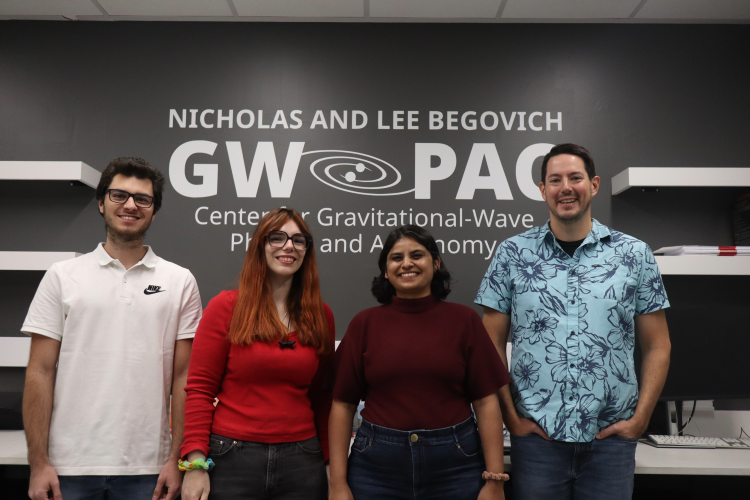
Joshua Smith, Cal State Fullerton professor of physics and Dan Black director of the Nicholas and Lee Begovich Center for Gravitational-Wave Physics and Astronomy, hosted three visiting scholars from around the world at CSUF, with a goal of identifying a future site for the Cosmic Explorer Observatory and developing optical technology for future gravitational-wave detectors.
The team was both diverse and multidisciplinary, consisting of Laurence Datrier from the University of Glasgow in Scotland, Disha Kapasi from the Australian National University, and graduate student Luca Craighero from Università di Torino in Italy.
Datrier was responsible for finding a home for the upcoming Cosmic Explorer, a large gravitational-wave detection observatory. Her work required evaluating geography, environmental noise, weather patterns and other factors that influence the location.
Craighero’s focus was on measuring an optical property called birefringence, a challenging task that requires precise equipment, such as lasers and mirrors. Meanwhile, Kapasi oversaw the optic experiments, including some conducted under extremely cold temperatures. Her research aims to enhance the current gravitational-wave detection technology.
Although Craighero and Kapasi were not directly involved in the location planning of the Cosmic Explorer, their research will benefit the technology and its future evolution.
Smith was the common denominator among these scholars. His role was to oversee all the research being performed, while also providing CSUF visiting scholars and students with a place to gain hands-on experience with gravitational-wave physics and astronomy research.
“I’m helping to work with them on writing publications about the research that we’ve done and collaborating with people at other universities, and in other countries in some cases, on the research that we’re doing,” said Smith.
Each one of these visiting scholars had a small group of CSUF students working and learning under their guidance. This was incredibly beneficial to students because these scholars are experts in their fields, allowing multicultural learning and creating a better melting pot of ideas.
Cal State Fullerton is excited to collaborate with international scholars and welcomes scholars from diverse fields of study to enhance campus research and projects. For international scholars or students interested in conducting research with Cal State Fullerton faculty, explore international students and scholars opportunities.