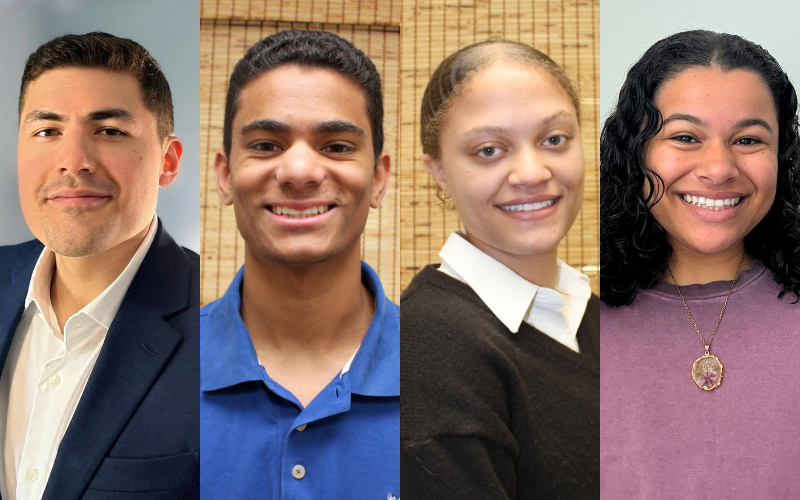
Over the past decade, the graduate and science entry pipeline programs, Big Data Discovery and Diversity-Research Education Advancement and Partnership program and its successor, the Neurocognitive Aging & Analytics Research Education program, led by Archana McEligot in partnership with the USC Stevens Neuroimaging and Informatics Institute, have successfully mentored six cohorts of students toward graduate school and professional careers in the STEM and biomedical fields.
Of the 36 alumni, 22 went on to graduate school and the other 14 are now working in science fields. As part of the inaugural cohort, Jonathan Chacon participated in the BD3-REAP program from 2016-18. He earned a Bachelor of Science in biological science with a concentration in cell and developmental biology. Faculty mentors in the pipeline programs supported Chacon’s academic and research journey, culminating in Chacon’s completion of a degree and his subsequent entry into a master’s program. He is currently a Ph.D. student at Weill Cornell Graduate School of Medical Sciences, where he studies computational biology and medicine in the Tri-Institutional Program. In Jan Krumsiek’s lab at Weill Cornell Medicine, Chacon’s research combines metabolomics and genomics, machine learning, and large-scale biobank data to develop precision risk scores for cardiometabolic diseases, with the goal of translating computational models into clinically actionable tools.
His path toward this work began at Cal State Fullerton through BD3-REAP program, where he worked with Math Cuajungco, professor of biological science, to find biomarkers that predict early metabolic changes in the brains of Mucolipidosis IV patients.
“This experience was crucial in sparking my interest in how metabolism contributes to disease,” said Chacon. After graduating from CSUF and prior to his Ph.D. program, he pursued a master’s degree in biology at Cal State LA as a RISE scholar.
“The BD3-REAP program was especially important in shaping my journey because it introduced me to statistical learning, new research methods and faculty mentorship that broadened my perspective beyond a traditional molecular biology path,” said Chacon. “It helped set me on the path toward computational biology.”
Nkosi Sampson was a part of the NAARE program from 2023-25. He earned a bachelor’s degree in mathematics with a concentration in probability and statistics. He is currently pursuing a master’s degree in data science through the University of Texas at Austin’s online Master of Science in data science program. During his undergraduate career, he researched risk factors related to Alzheimer’s disease by using a large data set and applying statistics and machine learning techniques.
In addition to his academic work, Sampson works in institutional research and data analytics at San Bernardino Valley College, where he supports data-informed decision-making related to student outcomes, future planning and equity-focused metrics. One recent highlight of his work was the development of the Course Scheduling Intelligence Dashboard, which was featured in the Wolverine Weekly school newspaper for its role in supporting strategic scheduling and enrollment planning.
“Overall, this experience has been incredibly fulfilling as it allows me to apply my statistical training to meaningful challenges in higher education while continuing to grow academically and professionally,” said Sampson.
Lesley Thompson and Ava Pimentel are two students in the NAARE program’s most recent cohort.
Thompson, a senior majoring in public health, has been heavily involved in research at CSUF. She is currently working on manuscripts examining the link between hypertension and Alzheimer’s disease in Black and African American people with Lohuwa Mamudu, assistant professor of public health, and McEligot, professor of public health. Outside of research, she is also an intern at A to Zen Complete Chiropractic.
“I am grateful for the experience that the NAARE program has given me both in researching and in giving me a network of professors and peers that I can rely on,” said Thompson.
Pimentel is studying public health with a minor American studies. At CSUF, she worked with Mamudu and McEligot to examine the differences in age and gender groups on Mini-Mental State Examination scores and EEG data. At her summer research extensive experience, her research project investigated the relationship between cardiovascular risk factors, lesion volume and sensorimotor outcomes after stroke. Outside of research, Thompson is completing an internship at the Raise Foundation and is also on the Spectrum Community Advisory Board for the LGBTQ Center of Orange County.
“The NAARE program provided me a space to get more comfortable in my research and statistics skills,” said Thompson. “I also appreciate the support and advice of the staff in applying to grad school.”
Both Thompson and Pimentel applied to master’s degree programs in public health and heard back from numerous recognized programs across the country. Thompson and Pimentel will be pursuing a Master of Public Health in epidemiology and biostatistics from UC Berkeley in fall 2026.
Visit the program website to learn more about NAARE and its cohorts of scholars.