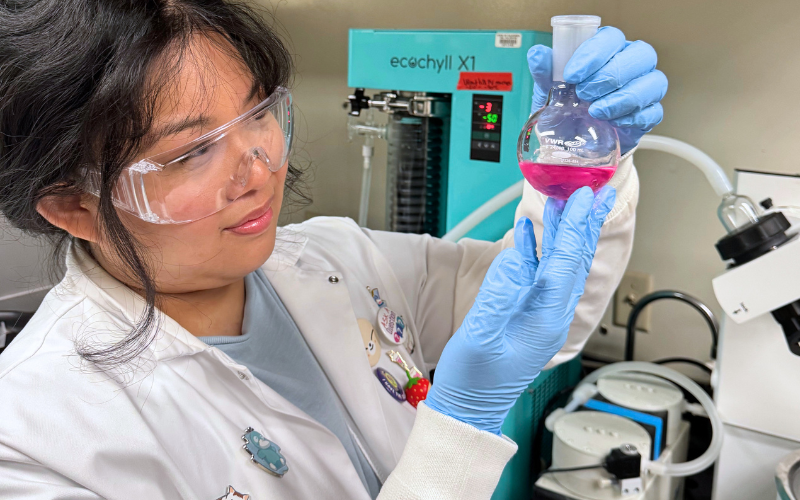
Long before she stepped into a chemistry lab, Amanda Tsang was already asking questions about medicine.
“Ever since I was a little kid, I had curiosity for the functions of ibuprofen and Tylenol and how they affect the body,” Tsang said.
A CSUF alum, Tsang earned her bachelor’s degree at Cal State Fullerton before applying to the university’s graduate program in chemistry. She said she was motivated to learn how medicinal chemistry works, so she reached out to Stevan Pecic, associate professor of chemistry and biochemistry, for mentorship and joined his lab.
That path led to work focused on early-stage discovery of non-opioid compounds that may one day inform new options for people living with chronic pain. Tsang pointed to CDC data showing about 1 in 5 adults in the United States experience chronic pain, and she said long-term reliance on common medications can come with risks.
“In Dr. Pecic’s lab, we’re trying to find an alternative where we can create a non-opioid drug without those adverse side effects,” she said.
Instead of targeting opioid receptors, the team studies compounds designed to affect two enzymes linked to pain and inflammation. Tsang helped synthesize new compounds and supported testing to see how they performed.
“In our latest project, we made 35 new compounds and evaluated them in biological assays,” she said. “Out of those, I synthesized 19.”
In early testing, one compound, called LD-28, stood out as especially strong and did not bind to opioid receptors. Follow-up testing also raised new questions the team will investigate as the work continues.
Pecic said the research is funded by the National Institutes of Health and reflects a modern medicinal chemistry strategy called polypharmacology by design.
“We intentionally design compounds to act on more than one biological target,” he said. “It is a promising direction for non-addictive pain research, and Amanda played an important role in building the compound library that we needed to evaluate.”
Tsang said Pecic’s mentorship shaped not only her research skills, but also how she learned to think and communicate as a scientist.
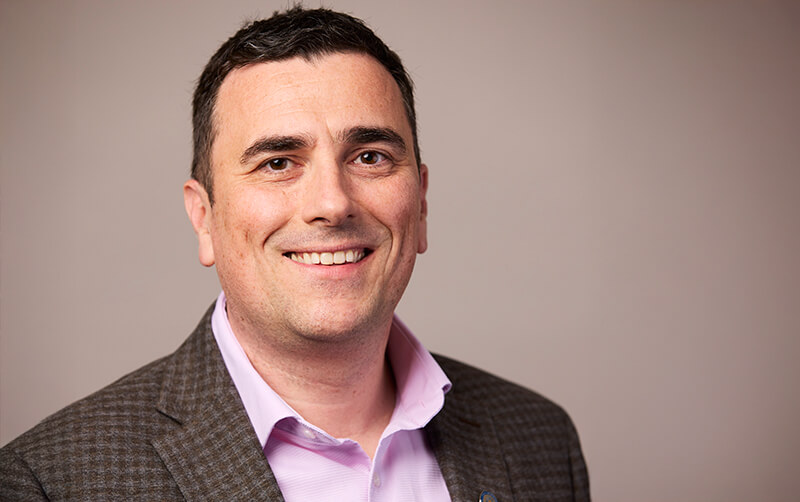
“Dr. Pecic is the expert in the research, but we’ve gotten to the point where we can communicate scientifically back and forth,” Tsang said. “Working with him has improved my critical thinking, and it has led to five publications with him. He has helped me communicate the science clearly.”
Those communication skills became especially important when Tsang took her work to a statewide stage.
Tsang’s presented the research at the CSU Student Research Competition, where she earned second place in the Biological and Agricultural Sciences category among hundreds of students across the California State University system. She said the competition pushed her to do more than present results. It required her to explain why the work matters.
“It was up to me to make it relatable and show that it will affect our lives in the future,” Tsang said.
She credited both her faculty mentor and support from the Undergraduate Research Opportunity Center, a unit within the Office of Research and Sponsored Programs, for helping her prepare for the competition, including guidance from Andrew Petit, associate professor of chemistry and biochemistry and a UROC faculty fellow.
“His feedback really helped strengthen my presentation,” Tsang said. “He always puts it in a positive way that is meaningful.”
Tsang also built her presentation and professional skills through other UROC opportunities, including EG-RSCA, a competitive program that supports graduate students in research, scholarship and creative activities. She also presented her work at CSUF’s Student Summer Symposium, gaining additional practice sharing her research with the campus community.
Nicole Bonuso, director of UROC, said programs such as EG-RSCA help students like Tsang communicate their research to broader audiences.
“When students have the chance to do meaningful research and present it, they learn how to connect their work to real people and real problems,” Bonuso said. “That combination of support and challenge is what helps students take the next step.”
This fall, Tsang will attend Brown University to pursue a Ph.D. and continue research in chemistry. She said her time at CSUF helped her see that path as possible.
“If you asked me four years ago what was next, I would have said med school,” Tsang said. “I did not expect I would be doing a Ph.D. The opportunities I had at CSUF are the reason I am taking this next step.”
By Nico Xepoleas