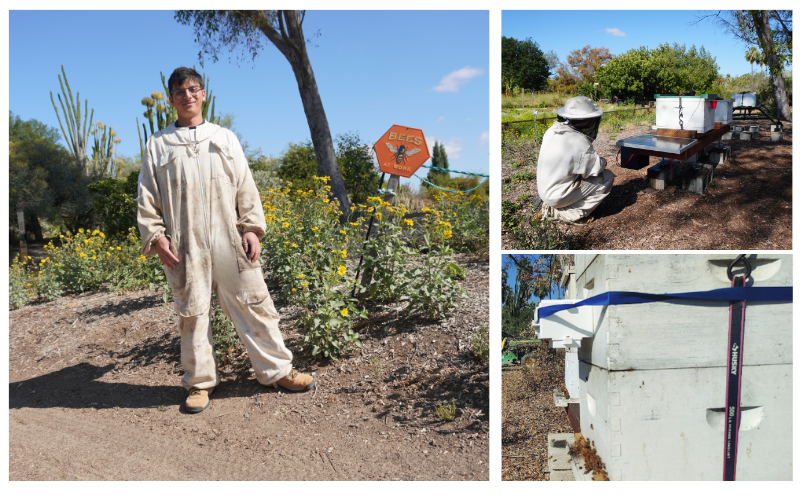
On the edge of the Arboretum and Botanical Garden at Cal State Fullerton, honeybees return to their hive carrying tiny packets of pollen, a protein source that can mean the difference between a thriving colony and a collapse. But the warning signs are easy to miss.
Class of 2026 computer science grad Kshitij Pingle is part of an interdisciplinary team developing a way to catch those signals early. The team is building a low-cost camera and computing system that records bees at the hive entrance. This work is supported through U-ACRE — Urban Agriculture Community-based Research Experience — a National Institute of Food and Agriculture-funded project.
Pingle’s machine learning models help detect pollen on returning bees, so the team can monitor hive activity over time.
“The goal is to spot trouble early so we can save a hive before it collapses,” Pingle said.
Low-Cost System for a High-Stakes Species
Honeybees are widely recognized as a cornerstone species for ecosystem stability and global food security. But tracking pollen collection by hand can be invasive, time-consuming and difficult to scale. By automating pollen detection from hive entrance video, the team aims to make monitoring easier to maintain over long periods and across more hives.
“Tracking pollen helps us track how well the hive is doing,” Pingle said. “Pollen is a really important nutrient source for bees. They need it to feed their larva for the survival of the colony.”
The monitoring unit is mounted at the hive entrance and records bees as they come and go. A downward-facing camera captures continuous video of the entrance, which the team’s models then analyze for bee and pollen activity. The unit uses a small computer and camera housed in a weather-tested 3D printed case designed for extended monitoring in the field.
“We have a camera system, basically a 3D printed box,” Pingle said. “It has a small computer and a downward-facing camera, and you attach it to the front side of a beehive.”
Teaching a Model to Find What Is Easy to Miss
Pingle began the project without prior machine learning experience. As he built the models, he also had to account for the realities of field video, where lighting changes and the subject does not behave like a predictable lab sample.
One of the biggest challenges was scale. Bees are relatively large in the frame, but pollen can be small and easy to miss. Pingle solved that with a two-step approach that mimics how a person would look at the footage. His code first finds the bee, then zooms in on just that bee so the model can focus on a cleaner image.
“Bees are really fickle because they are living organisms,” he said. “If the model has to search the whole frame, it misses the pollen. When I isolate the bee first, the detection gets much more reliable.”
So far, the models can identify bees with about 80% accuracy, and pollen detection is around 85-90% as the team builds a stronger dataset.
Mentorship Across Disciplines
Pingle’s work is supported by faculty mentors across three areas: Kanika Sood, associate professor of computer science; Jin Woo Lee, associate professor of mechanical engineering; and Sara Johnson, professor of anthropology.
“This project is a great example of applied AI with purpose,” Sood said. “It blends strong technical execution with a clear public benefit, and Kshitij learned to communicate that value clearly to both technical and non-technical audiences.”
Lee emphasized that building technology for real environments requires thinking beyond performance alone, especially when devices interact with living systems.
“Engineering is never just about building a device,” Lee said. “It is about understanding who will use it, where it will be used and what unintended impacts it might have. This project reflects that mindset because the design choices were guided by the real environment and the living system it interacts with.”
For Johnson, who is also the director of U-ACRE, the project’s success is tied to what pollen can reveal about bee behavior within and across colonies.
“Pollen is a key indicator,” Johnson said. “It helps us understand variation in foraging behavior, and it gives us a window into colony health over time.”
CSU Student Research Competition and UROC Support
Pingle conducted the research as a UROC Fellow, supported by the Undergraduate Research Opportunity Center, a unit within CSUF’s Office of Research and Sponsored Programs.
“I really, really enjoyed my UROC fellowship,” he said. “The money really helped me because I could scale my research.”
He later presented the team’s work at the California State University Student Research Competition, where he earned first place in Interdisciplinary Research and was one of nine student researchers to receive an AI Enabled Research Award.
“The judges challenged me from every angle,” Pingle said. “I had to explain the computer science, but also the biology and the engineering, and defend why the approach mattered.”
He emphasized that UROC helped him strengthen his presentation and communicate the research clearly to judges.
After graduating from CSUF, Pingle will begin a master’s program in computer science at UC Irvine. He hopes to continue building on the project and its long-term potential, from supporting earlier signals of colony stress to generating continuous data that can help researchers, ecologists and public health officials understand environmental shifts.
“I like working on research that actually solves problems in the world,” Pingle said.