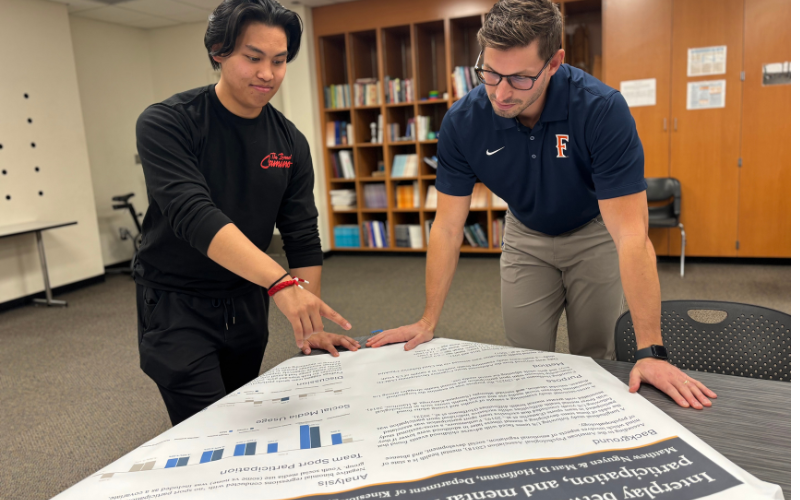
For many children, playing sports is more than just a game. It can be a lifeline for mental health, helping them build confidence, friendships and resilience. However, the connection between sports, mental well-being and other influences — like social media — is complex. For Matthew Nguyen, a graduate student in kinesiology at Cal State Fullerton, that complexity is what makes his research so compelling.
Under the guidance of Matt Hoffmann, associate professor of kinesiology and a leading researcher on youth sports and mental health, Nguyen studies how youth mental health, sports participation and social media interact during a critical stage of development.
“We as a society really value our children’s development,” Nguyen said. “So, understanding how sports and mental health influence each other is really important.”
Looking at the Full Picture
Working with Hoffmann, Nguyen analyzed data from a national study that follows nearly 10,000 children across the United States over time. The research focuses on youth between ages 9 and 14, when habits, relationships and self-perception begin to take shape.
Rather than asking a one-way question, Nguyen approached the research from multiple angles. He examined how sports participation relates to mental health, how mental health shapes participation and how social media fits into both.
“We wanted to see both directions,” Nguyen said. “Does playing sports improve mental health, or does mental health determine whether kids play sports at all?”
The answer turned out to be more complex than expected.
Who Gets to Play
Nguyen found that youth who participate in sports tend to report better mental health, but that was only part of the story.
“What surprised us was that mental health was actually a stronger predictor of whether kids participate in sports,” he said.
Youth experiencing higher levels of anxiety, depression or social challenges were less likely to take part in sports. That finding shifts the conversation, as noted by Hoffmann, whose previous work has shown that youth who participate in team sports report fewer mental health difficulties.
“That is a critical insight,” Hoffmann said. “The kids who might benefit the most from sports are sometimes the least likely to take part.”
A More Nuanced View of Social Media
Instead of showing a clear negative impact, the data suggested that social media can sometimes be connected to increased sports participation. “One possibility is that kids see their friends posting about sports and feel encouraged to join,” Nguyen said.
At the same time, social media didn’t appear to have a strong negative effect on mental health in the way some might expect. Simply using it more was only modestly linked to worse mental health outcomes. “What may matter most is not just how often kids use social media, it’s how they interact with it,” Nguyen said.
That perspective reflects Nguyen’s broader approach to the research. Rather than isolating one factor, he looks at how multiple influences shape youth behavior and well-being at the same time.
From Research Experience to Real-World Impact
They were able to conduct this research thanks to support from the Engaging Graduate Students in Research, Scholarly and Creative Activities program, which provides graduate students and faculty mentors with stipends to work together on hands-on research projects. The program is administered by the Undergraduate Research Opportunity Center within the Office of Research and Sponsored Programs. Through that support, Nguyen was able to step directly into an active research project and begin analyzing data early in the process, an experience that shaped both his skills and confidence.
“I think one great aspect of the program is that it allows students to immediately dive into ongoing faculty research,” Hoffmann said. “When students can begin analyzing data and working through problems with a faculty member, it jumpstarts their learning and motivation and shows them how they can be part of solving real-world problems.”
For Nguyen, that hands-on experience also reinforced the importance of mentorship.
“Staying consistent with communication was one of the biggest lessons for me,” he said. “It helped build a strong working relationship and kept the project moving forward.”
That collaborative approach has already led to multiple conference presentations, giving Nguyen the opportunity to share his findings with other researchers and gain feedback from the broader academic community. Building on that momentum, he is preparing submissions for a national conference and a peer-reviewed journal, ensuring the research contributes to ongoing discussions about youth sports, mental health and social media.
As Nguyen looks ahead, the project continues to shape his goals. He plans to pursue a second master’s degree in counseling and work with athletes, focusing on mental health and performance.
“This research is the foundation of what I want to do,” he said.
More broadly, Nguyen hopes his work encourages a more thoughtful approach to supporting youth. His findings suggest that mental health, sports participation and social media are closely connected, and that addressing one requires understanding all three.
“If we understand what keeps kids from participating, we can create better opportunities to support their growth and well-being,” Nguyen said.