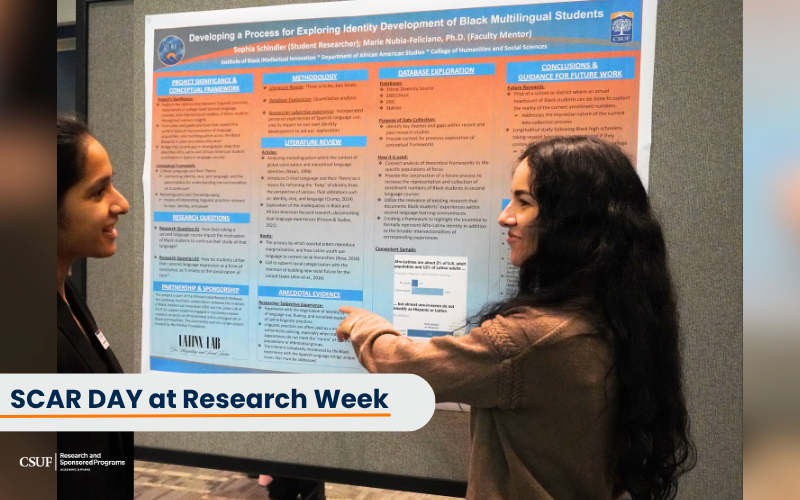
For Sophia Schindler, presenting at Cal State Fullerton’s Student Creative Activities and Research Day was not just about sharing results. It was about explaining how her research took shape.
Hosted by the Undergraduate Research Opportunity Center during Research Week, SCAR Day featured undergraduate and graduate students presenting projects across multiple disciplines, representing seven colleges and 19 departments. The annual event is designed to provide students with an opportunity to publicly share the results of their scholarly or creative efforts while gaining valuable experience communicating their work.
Schindler’s project focused on the experiences of Black students in college-level Spanish courses, but the most significant finding of her research was not a result. It was a gap.
As she explored existing literature and data sources, Schindler found that information on Black multilingual students in language courses was limited and inconsistently collected, making it difficult to fully understand where these students are represented or how their experiences are documented.
“I thought the data would be larger and easier to find,” Schindler said. “It was surprising to see how imprecise the data collection process is, especially when trying to understand where Black multilingual students are.”
Her work is part of the LIFT Project — Language, Identity and Fluency as Black Tradition — an initiative of the Institute of Black Intellectual Innovation that examines the intersections of language, identity and Black student experiences.
The LIFT Project is a collaboration between the Institute of Black Intellectual Innovation and the Latinx Lab for Storytelling and Social Justice, a Mellon Foundation-funded initiative in the College of Humanities and Social Sciences. The Latinx Lab is led by director Mario Obando, associate professor of Chicana and Chicano studies, whose work focuses on storytelling as a way to better understand communities and address structural inequities.
Rather than focusing only on interpretation of Black multilingual student data, Schindler’s work shifted toward identifying what information is missing and what would need to be collected in order to continue research in this area.
“This project is really about understanding how language shapes identity,” she said. “For Black students, especially those navigating Spanish language spaces, there’s a unique experience that often goes unrecognized.”
Her faculty mentor, Marie Nubia-Feliciano, director of the Institute of Black Intellectual Innovation, said this shift was a key part of Schindler’s development as a researcher.
“When the data was not readily available, Sophia adapted,” Nubia-Feliciano said. “She began thinking critically about what kinds of data would need to exist in order for this research to move forward. That ability to adjust, ask new questions and keep moving is what strong research training looks like.”
SCAR Day serves as a culminating experience for many students, offering the opportunity to present their work publicly while building skills in communication and professional development. UROC, a unit within the Office of Research and Sponsored Programs, supports students throughout that process by connecting them with mentorship, funding and research opportunities.
“Today reflects the full journey of research,” said Nicole Bonuso, director of UROC. “We are seeing students contribute to a vibrant and interconnected research community at Cal State Fullerton.”
“SCAR Day exemplifies what student research can be,” added Binod Tiwari, associate vice president for research and sponsored programs. “It highlights the dedication of our students and the impact of mentorship across disciplines.”
In addition to student presentations, the event recognized outstanding contributions to research and mentorship. Alison Marzocchi, professor of mathematics, was named UROC Faculty Mentor of the Year for her commitment to supporting student researchers.
Julia Butz, a kinesiology major, received the Undergraduate Student of the Year award, while Dulce Alcazar, a psychology major, was honored as Graduate Student of the Year.
SCAR Day poster and oral presentation award winners included:
Poster Presentations:
Undergraduate Students
- First place: Jeksin Ghanem, biological science and public health
- Second place: Ethan Irwin, psychology
- Third place: Sophia Schindler, African American studies
Graduate Student
- First place: Salma Valladares, biology
Oral Presentation
- First place: Lily Merrick, kinesiology
For Schindler, the experience reflected what research often requires.
“You learn that research is not always straightforward,” she said. “It is about figuring things out as you go.”
Students interested in getting involved in research and creative activities can learn more about opportunities through UROC.