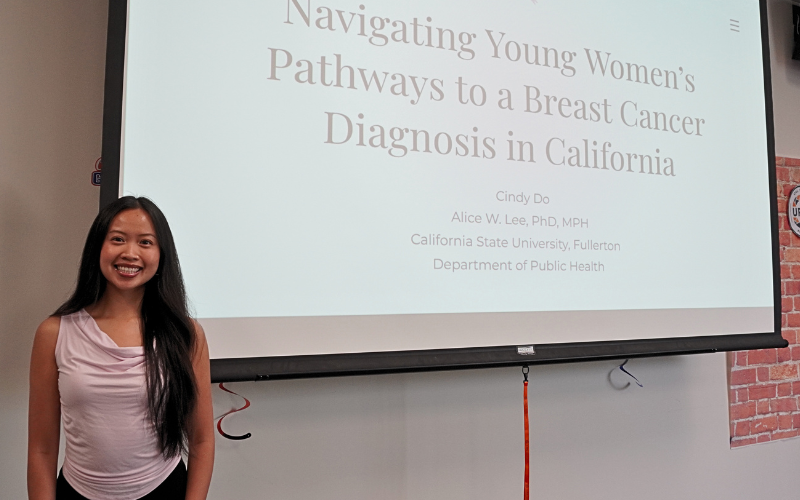
Receiving a breast cancer diagnosis before age 40 can come with unique challenges. As breast cancer incidence rises among this population, many women fall outside routine screening guidelines and may experience delays in receiving care.
At Cal State Fullerton, psychology major Cindy Do is helping researchers better understand why. Mentored by Alice Lee, associate professor of public health, Do joined the Breast Cancer in Young Women: Awareness, Views, Experiences Study, a grant-funded project supported by the Regents of the University of California. The BRAVE Study examines the pre-diagnostic experiences of young breast cancer survivors and aims to identify ways to improve patient-centered care.
Led by Lee, the BRAVE Study uses qualitative research methods to explore how young women navigate the path to a breast cancer diagnosis. The study examines experiences from both survivors and healthcare providers to better understand where challenges arise and how communication and care can be improved. The research team partnered with The Young Breast Cancer Project, a San Diego-based nonprofit organization focused on raising awareness of young breast cancer, to recruit participants through community partnerships, social media outreach and personal connections.
Do’s interest in health disparities grew through her participation in the Professions Advancing and Transforming Health Academy, a program that Lee leads, which connects students with research and mentorship opportunities as they pursue health-related career pathways. While participating in the PATH Academy, Do learned about Lee’s breast cancer research study and wanted to get involved.
Lee invited Do to join the research team, providing her with the opportunity to advance from learning about research in the classroom to experiencing the process firsthand.
“Before this, research felt like something I learned about from a distance,” Do said. “Being directly involved showed me how much thought goes into every step of the process and how research can help improve people’s lives.”
As part of the BRAVE Study, Do helped conduct focus groups with young breast cancer survivors and interviews with healthcare providers. She was involved in multiple stages of the research process, from shaping questions and analyzing findings to sharing results. The experience showed her how researchers can turn individual stories into knowledge that informs communities and improves care.
These conversations revealed the complex challenges young women can face while seeking care for breast cancer. Many survivors described feeling that their breast health concerns were dismissed or minimized, often due to their age.
“Understanding how survivors trusted their intuition and experienced dismissal in the clinical setting has been very empowering,” Do said. “As a researcher, I can help bring attention to the experiences of these young women, who were so vulnerable and passionate about sharing their stories.”
At the same time, interviews with healthcare providers offered another perspective. The findings suggested that the experiences young survivors described were not necessarily intentional, but could stem from institutional limitations, clinical guidelines, and gaps in communication between providers and patients.
The BRAVE Study reinforced the value of qualitative research, which focuses on understanding experiences and perspectives rather than measuring outcomes solely by numbers. For Do, the project demonstrated how listening to individual stories can help researchers identify opportunities to improve care.
“One of the biggest things I learned is that qualitative research is not always about how many people experience something — it’s about understanding why,” Do said. “We wanted to understand the experiences of these survivors and what their stories can teach us about improving care.”
The project also highlighted the importance of patient-centered care. While breast cancer screening guidelines provide important standards for care, Do said the findings demonstrate the need to recognize patients whose experiences fall outside those expectations.
“We don’t want the message to be that young women have to advocate for themselves in order to be heard,” Do said. “It’s about creating better communication between patients and providers, so patients understand their care and feel supported throughout the process.”
Mentoring students like Do is a key part of Lee’s commitment to expanding access to meaningful research experiences.
“I established the PATH Academy to create opportunities for students to explore health careers while gaining hands-on experience that extends beyond the classroom,” Lee said. “Through mentorship and research experiences, students develop the skills and confidence to contribute to meaningful work that can make a difference in our communities.”
Lee’s mentorship, combined with support from campus programs like the Undergraduate Research Opportunity Center Fellowship, have helped Do develop professional research skills and prepare for the next stage of her academic journey.
In the fall, she will begin the Master of Social Welfare program at UCLA, where she plans to continue exploring health disparities and advocating for underserved communities.
For Do, the experience reinforced that research is not just about discovering answers — it is about understanding people.
“Research gives us the opportunity to better understand experiences that might otherwise be overlooked,” Do said. “Those stories can help us identify what needs to change.”