A single sentence, read aloud during CSUF Research Week, captured a big idea about who research is for: “By stepping into high performance computing, I hope to show that students from the humanities belong in the world of data just as much as anyone else.”
The quote, from humanities student Michelle Rodriguez, was shared by the Titan Supercomputing Center during the Centers and Institutes Lightning Talks and reflected a broader truth across campus. CSUF’s centers and institutes help more people participate in research, and they help faculty and students connect across disciplines by linking expertise, resources and opportunities.
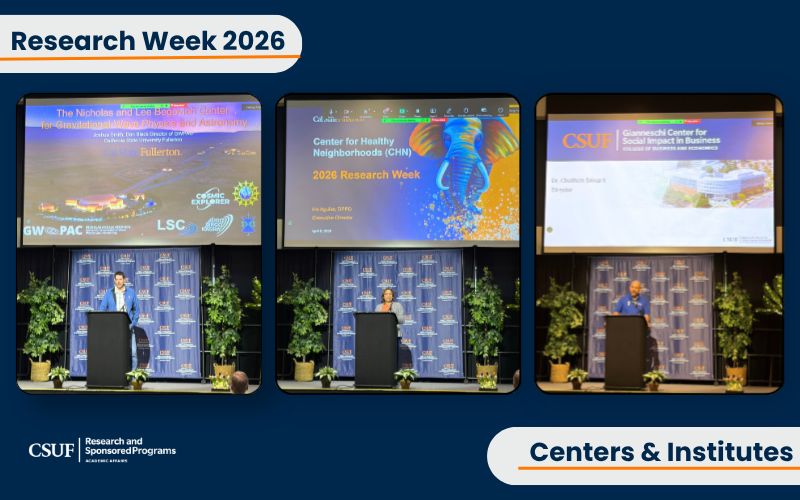
Hosted by the Office of Research and Sponsored Programs, the Centers and Institutes Lightning Talks were designed to spark collaboration across disciplines and make campus resources easier to find and use. Rather than functioning as stand-alone units, campus centers and institutes often serve as the connective tissue of CSUF’s research ecosystem, supporting proposal development, strengthening methods and evaluation, training students, and building durable community partnerships.
In opening remarks, Binod Tiwari, associate vice president for research and sponsored programs, emphasized the role centers and institutes play in advancing the university’s mission.
“Our centers and institutes represent some of the most impactful and collaborative work happening across our campus. They bring together faculty, staff and students to advance research, drive innovation and engage meaningfully with our community,” Tiwari said.
This year’s lightning talks featured 10 centers and institutes, offering a snapshot of the breadth of research support and engagement happening across CSUF.
For faculty and staff, some centers function as research infrastructure that strengthens projects from design through reporting. Laura Gil Trejo, director of the Social Science Research Center, described her center as one that supports both campus and external partners.
“We specialize in providing high-quality, state of the art, transparent research support services, and we also offer training, instruction and employment opportunities for students in the conduct of applied social science research,” Gil Trejo said.
Other centers expand campuswide capacity by making advanced tools and expertise more accessible. Jessica Jaynes, director of the Titan Supercomputing Center and professor of mathematics, described a mission rooted in broad access.
“Our goal is really to empower all, and I mean all, students and faculty to push the boundaries of what’s possible through computation,” Jaynes said.
Many centers also connect research to real-world needs through community partnerships and hands-on learning. Iris Aguilar, executive director of the Center for Healthy Neighborhoods, described a model rooted in partnership with the city of Fullerton and the Richmond Park community.
“We run our programming out of the Richmond Park Community Center, providing services to the community, and also serving as a real training ground for the students here at Fullerton,” Aguilar said.
In a student testimonial shared during Aguilar’s talk, student intern Jocelyn Malasco added, “I love being an intern at the center because I get to serve underresourced families. The support here is immense.”
Collaboration itself was a central theme during the presentations. At the Gianneschi Center for Social Impact in Business, Chethan Srikant, academic director and associate professor of management, emphasized partnership as a core strategy.
“Social impact cannot be a silo on its own, and we truly believe in being a multi-stakeholder collaborative platform,” Srikant said.
Student outcomes remain at the heart of many centers’ work. Joshua Smith, professor of physics and Dan Black director of the Nicholas and Lee Begovich Center for Gravitational-Wave Physics and Astronomy, pointed to that long view. “That’s really the heart of our center, the students that we work with, and seeing them go off to the amazing things that they do,” Smith said.
CSUF has almost 50 campus centers and institutes across multiple colleges and disciplines, many actively seeking collaborators, student researchers, and campus and community partners. Faculty and staff who are building proposals can connect with centers early to strengthen project design, evaluation plans and broader impacts. Students can find research and internship opportunities that match their interests, while community partners can connect with CSUF teams working on issues that matter locally and regionally.
To find a potential partner or opportunity, explore the CSUF Centers and Institutes online directory.
Centers featured during the Research Week Centers and Institutes Lightning Talks, included:
- Social Science Research Center
- Institute of Black Intellectual Innovation
- Gianneschi Center for Social Impact in Business
- Center for Applied Biotechnology Studies
- Titan Supercomputing Center
- Nicholas and Lee Begovich Center for Gravitational Wave Physics and Astronomy
- Center for Healthy Neighborhoods
- Center for Successful Aging
- California Desert Studies Consortium
- Catalyst Center for the Advancement of Research in Teaching